Artist Birthday: Max Beckman (1884-1950 Germany)
Max Beckmann was a German Expressionist who, before World War I (1914-1918) painted in an academic realist style. After experiencing the horrors of that war, his paintings reflected his disgust for the decadence and nihilism of German society in compositions that are often difficult to completely decipher.
Artist Birthday for 13 February: Max Beckmann (1884-1950 Germany)
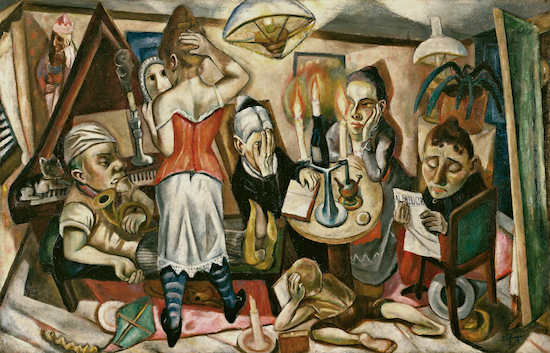 |
| Max Beckmann, Family Picture, 1920, oil on canvas, 65 x 101 cm The Museum of Modern Art, New York, © 2026 Artists Rights Society (ARS), New York (MOMA-P0417bkars) |
Family Picture is not symbolic of Beckmann's inner turmoil, but rather that of Germany between the two world wars (1914-1918, and 1939-1945). Germany's economy was shot, millions were jobless, and corruption was rampant. In this milieu, his skewed vision of reality told a bleak story. This painting depicts the one room apartment of a wounded German ex-soldier (on the left with bandaged head) and his family. Much of the allegories are taken from Medieval German art -- the woman with the mirror symbolizes the sin of useless vanity, and the three women around the table the three ages of human beings – youth, adulthood and old age.
The skewed space is reminiscent of German medieval manuscript illustrations or ivory carvings, although it could also represent the topsy-turvy spaces created in Cubist compositions. The jagged edges of the forms recall the panes of Gothic stained glass, or the sharp contour linearity of early German Renaissance prints. The stage-like compressed space encourages a feeling of entrapment or hopelessness, while heightening the tension intended for the viewer to feel. Ironically, the wounded ex-soldier seems to be the only one of clear vision in this composition.
Background
Expressionism in northern European art of the early 1900s was an offshoot of art movements in the late 1800s that emphasized romanticism, expressive color, or symbolic (rather than representational) subject matter. The objective in expressionist work was to express the artist’s feelings about the subject and to elicit an emotional reaction from the viewer.
German Expressionists built on the aims of Post-Impressionist artists who rejected the Impressionist emphasis on optical accuracy and turned towards the world of the spirit. They employed a variety of styles to give visible form to their feelings, often relying on direct, sometimes crude expressions. Their art was basically an expression of inner meaning through outer form.
Late 1800s inspirations for German Expressionists included Van Gogh, and Symbolist artists Böcklin, Hodler, Munch and Ensor. Symbolism represented a rejection of the scientific emphasis of Impressionism of light and color in favor of pathos-heavy subjects from Greek and Roman literature as well as German Romantic literature,. Expressionists were also influenced by German medieval and Renaissance woodblock prints, non-western art such as African and Oceanic, folk art, and the art of the Romantic and Hellenistic periods in western art. Symbolism, by far, had the strongest impact on subject matter.
Born in Leipzig, Max Beckmann demonstrated an early interest in art, eventually studying at the Ducal Art Academy in Weimar in 1900. His primary teacher was the Norwegia painter Carl Frithjof Smith (1859-1917), who painted sentimental realist genre scenes of rural Norwegian life. Smith instilled in Beckmann an abiding appreciation of authentic reality. Although this nuanced through his lifetime, Beckmann's work never revealed an inclination towards complete abstraction.
Beckmann's earliest works were influenced by Impressionism and Post-Impressionism (particularly Cézanne) after a trip to Paris in 1903. After a visit to Italy in 1905, however, he was impressed with the work of Vincent van Gogh (1853-1890) and Edvard Munch (1863-1944), and thereafter his work turned towards Expressionism. His work up until World War I (1914-1918) were primarily narrative and religious works set in the skewed space of Cubism and Cézanne's late paintings, infused with the German Expressionist bent towards late northern Gothic contorted figuration.
Beckmann's ghastly experiences with death and injury as a medical orderly in World War I profoundly impacted his work. His work retained the Expressionistic color and jagged form, but left the realm of symbolic or allegorical narrative for narrative on the reality of post-war Germany as he saw it. His scenes of the dismal, desperate, and often profane daily life quickly attracted the attention of a group of artists in a movement called The New Objectivity. The art of this movement was primarily politically and socially oriented, within a variety of Expressionistic styles.
From the 1920s until his death, Beckmann's style altered little, as his subjects explored the ironies of human existence during a tumultuous time period. His paintings came to be characterized by jarring color, jagged line and fragmented shapes that were reminiscent of Gothic stained glass and the work of French painter Georges Rouault (1871-1958). Expulsion from his teaching job in Frankfurt by the Nazis in 1937 caused Beckmann to move to Amsterdam and ultimately the US, never to return to Germany.

Comments