Artist Birthday: Martin Ramírez (1885/1895-1960)
Like most Visionary artists, Ramírez’s works are combinations of fantasy, personal visions, and a obvious joy in either nature or our mutual humanity. In his highly detailed drawings, he reveals his obvious affinity for the part of the US to which he emigrated.
Artist Birthday for 30 January: Martin Ramírez (1885/1895-1960 US, born Mexico)
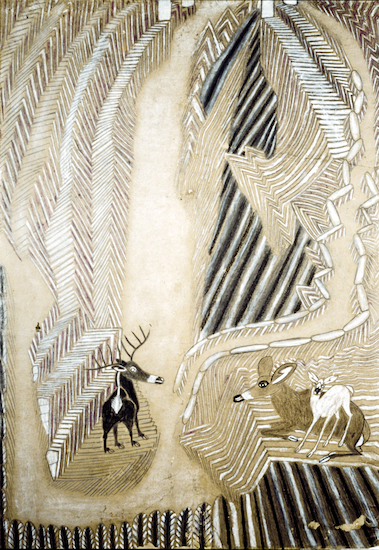 |
| Martin Ramírez, Untitled, 1950s?, colored pencil and crayon on paper, 86 x 60 cm Image courtesy of the Phyllis Kind Gallery, Chicago/New York, © 2026 Artist or Estate of Artist (8s-18173) |
Much of the imagery in Ramírez's work concerned railroads -- on which he worked -- and cowboys from his past in Mexico. He also executed many drawings of animals, particularly reindeer, which he had seen while in northern California. His works typically employ a vertical perspective which is tightly organized by rows of parallel lines.
The parallel lines often form a rhythmic enclosure to the subject. His works often hint at fleeting moments or movement, particularly in his animal works. They reveal a mind keenly aware of what he had observed, incorporated into a personal fantasy world.
Background
There is a long tradition of "folk art" all over the world. Folk art used to be the term that covered a broad range of art produced by people who were self-taught, or had little training in art at all. Folk art is sometimes divided into two genres -- 1) the art of self-trained artists, who, although not producing painting or sculpture in a style that reflects art school training, earn a living with their art; and 2) the art of those with little or no training whatsoever who produce works of art primarily for the joy of creating.
Such art was denigrated as "outsider art," implying that it was outside of the official "art world." The term “outsider art” was coined in the 1970s as an British (mis-) translation of the French modernist Jean Dubuffet’s (1901-1985) stylistic description (in French) Art Brut (Raw Art) for the huge personal collection of such art that he had starting in the 1930s. Much of the art in Dubuffet's collection was produced by artists who were either mentally or physically disabled.
"Outsider" has now been changed to "Visionary", because many of the Visionary artists work from personal spiritual or emotional visions that defy conventional representation. A major tendency in Visionary Art is that the work was usually created with the artist's personal perceptions of the elements of art and principles of design.
Martin Ramírez, born in Jalisco, is thought to have migrated from Mexico into the US between 1910 and 1915. He moved to northern California to work on the railroads being built there at the time. At some point in the 1930s he was hospitalized for mental illness near Sacramento. By 1948 he was discovered to have begun drawing on available bits of paper glued together with paste made of bread or potatoes and spit. After a visiting psychologist discovered his work around 1950, he began bringing Ramírez art materials such as colored pencils, crayons and paper.
Ramírez's produced over 300 drawings in his lifetime. They were first exhibited on college campuses. Drawings sent by the psychologist to the Guggenheim Museum in 1955 were not accessioned by that museum until the mid-1990s. A large number of Ramírez's drawings were acquired by Chicago Imagist (“Hairy Hoo”) Jim Nutt (born 1938) whose own artwork is characteristically faux-primitive in style. They ended up in his sales gallery, Phyllis Kind.
Correlations to Davis programs: A Global Pursuit 2E, Unit 1 Artists Send Messages, 1.3; Davis Collections -- Visionary / Folk Art

Comments