Artist Birthday: Jules Olitski
Jules Olitski was a Ukrainian-born American artist who was instrumental in developing the Color Field painting style. Color Field, which involved staining canvas rather than using brushes, was the antithesis to the then-contemporary mania for “personal gesture” in Abstract Expressionist circles.
Artist Birthday for 27 March: Jules Olitski (1922-2007, US born Ukraine)
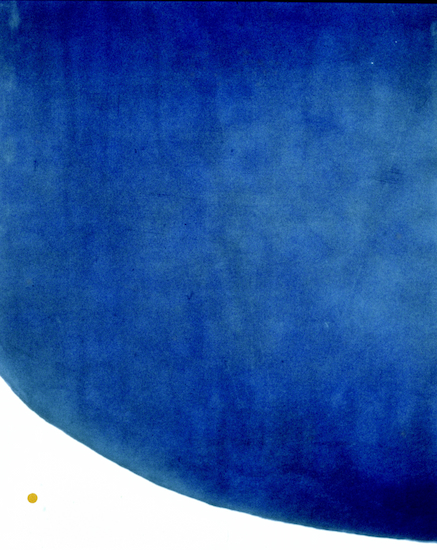 |
| Jules Olitski, Julius Orange, 1963, acrylic on canvas, 211 x 173 cm Image courtesy of Richard Gray Gallery, Chicago, © 2026 Estate of Jules Olitski / Licensed by VAGA at Artists Rights Society (ARS), New York (8s-180400olvg) |
Before Olitski began using a spray gun to paint (around 1965), his works were characterized by large, assertive areas of pure color with which he stained the canvas. He explored circular forms, generally off-center and irregular. They create vaguely organic effects reminiscent of the work of Jean Arp (1886-1966). The elimination of depth gave a new understanding to the nature of the picture's surface not as a "window" into another space, but pure creation in color and shape without reference to any human activity. Julius Orange is a play on words of the 1960s fast food juice franchise Orange Julius. Olitski has cleverly contrasted a dot of orange with a massive swathe of blue, to present vastly different sizes of complementary colors.
Background
A number of exhibitions held in the 1960s focused attention on changes occurring in American abstract painting. Abstract Imagism, Systemic Painting, and, the most enduring -- Color Field painting -- were terms used to identify this new trend in abstraction. The broader term of "post-painterly abstraction" was applied to the work of this group of painters to differentiate the trend from the action painting of Abstract Expressionism.
The exhibitions illustrated just how many younger painters were trying to break with what they felt was the tyranny of Abstract Expressionism’s emphasis on individual brush stroke. While artists used many different approaches, the emphasis was on pure abstract painting, with a subordination of brush stroke and paint texture.
Jules Olitski was born to a Jewish family as Jevel Demikovsky in Snovsk, Ukraine. After his father died, his mother and grandmother took him to the US in 1923 and they settled in Brooklyn. Olitski eventually took the surname of his mother’s second husband. As a child, Olitski demonstrated a talent for drawing and he began taking art classes in his teens. He studied at the Pratt Institute in New York in 1939, and from 1940 to 1942 at the National Academy of Design. After military service in World War II (1939-1945), during which time he became a US citizen, Olitski spent 1949 to 1951 in Paris where he became aware of the French version of Abstract Expressionism, Art Informel, which, like Abstract Expressionism rejected pre-war abstraction based on geometric formulas in favor of free-form, spontaneous abstraction based on emotion and intuition.
In 1951 Olitski began studying at New York University where he received a BFA (1952) and MFA (1954). His early works were monochromatic canvases influenced by artists like Hans Hofmann (1880-1966). Being part of the group of artists rejecting the heavy impasto and gestural brushwork of Abstract Expressionism, he joined artists like Helen Frankenthaler (1928-2011), Kenneth Noland (1924-2010), Ellsworth Kelly (1923-2015) and Morris Louis (1912-1962) who expanded the genre of color field into the staining of raw, unprimed canvas. This characterized Olitski’s work of the late 1950s into the early 1960s. In 1964 he began using rollers to press paint into the canvas in wispy, superimposed sheets of uninterrupted color.
Olitski’s epiphany came in 1965 when he began using industrial spray guns to apply thin veils of paint on unprimed, unstretched canvas. This groundbreaking technique removed any last vestige of the personal touch of the artist. In the early 1970s he change his technique again, applying paint in thick impasto with dynamic brush work. In the 1980s and 1990s he once again explored depth, creating paintings inspired by landscapes around his homes in Florida and New Hampshire. He returned to total abstraction in the late decade of his life.

Comments