
Artist Birthday: Josiah Johnson Hawes (1808-1901 US)
Josiah Johnson Hawes was part of the successful photography duo of Southworth and Hawes, which had a flourishing Daguerreotype business in Boston from 1843 to about 1863. After the firm dissolved in 1863, Hawes continued on his own in the same studio creating portraits and scenes of Massachusetts until his death in 1901. Hawes brought his considerable experience with the Daguerreotype process having learned it from a pupil of process's founder.
Artist Birthday for 20 February: Josiah Johnson Hawes (1808-1901 US)
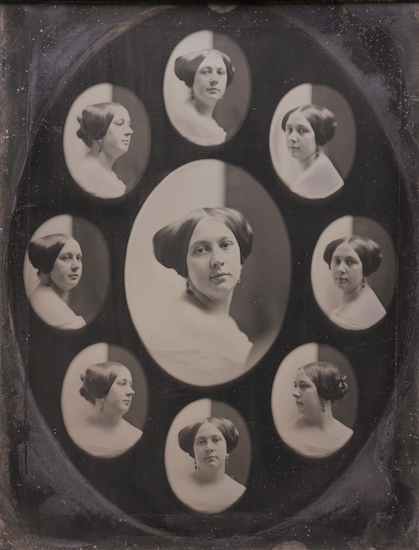 |
| Southworth and Hawes, Portrait of a Woman, 1850s, medallion Daguerreotype, 21.6 x 6.5 cm overall. Image © 2026 Museum of Fine Arts, Boston (MFAB-121) |
These multiple views of an unknown woman show how Southworth and Hawes sought not only to capture the physical characteristics of the sitter, but also something of her personality. They sought to capture the best possible reflection of the sitter's character and most flattering expression. Multiple oval portraits like this were by far the most expensive Daguerreotype product, This was produced on a sliding plate-holder that was patented by Southworth in 1855.
Southworth and Hawes further exploited the medallion style with eight rotating poses around the central image. This gave not only more insight into the woman's looks, but also gave the illusion of movement, or elapsing time. The brilliant, mirror-like image is finely detailed, with the subtle lighting giving a depth and plasticity to the portrait. At the same time, the shadows are soft and flattering, just what the elite of Boston desired in a photographic portrait.
Background
The Daguerreotype was by far the more popular photographic medium in the early days of portraiture because of the. The Daguerreotype was a French process introduced to the United States in 1839. Within three years it was wildly popular in the United States. The Daguerreotype produced a one-of-a-kind image that developed on a highly polished silver-coated copper plate. The image produced was a positive. Because the metal plate was delicate, subject to damage from fingerprints or moisture, it was usually mounted in a case under glass often in a leather or velvet bound cover. Mounting a portrait likeness in a special case to protect it hearkens back to the miniature or silhouette portraits that were treated in a similar fashion.
Southworth and Hawes was one of the earliest Boston photographic studios, operating from 1843 until 1863. They worked exclusively in the Daguerreotype process, paying little or no attention to developments in paper photographic processes. Their portrait studio catered to the wealthy, as well as to celebrities and public officials. They were the first American portrait studio to establish strict guidelines for differences in demeanor between public and private portraiture.
Josiah Johnson Hawes was born in East Sudbury, Mass. He worked as an itinerant portrait painter after 1829. In 1840, after hearing a lecture by Louis Daguerre's (1787-1851) American agent, François Gouraud (1808-1847), he became enthusiastic about photography. He became trained in the process starting in 1841.
Albert Sands Southworth was born in West Fairlee, Vermont. After hearing Gouraud's lecture in 1840, he opened a studio in Cabotville which went under because of his experimentation in the Daguerreotype process that proved a failure.

Comments