Artist Birthday: John Smibert (1688-1751 US, born Scotland)
The first successful, trained painter to open a studio in the American colonies (in Boston), John Smibert represented the archetypal society portrait painter that the newly prosperous New England colonists were hungry for in the early 1700s. He established an aesthetic that was imitated by many other successful American artists of this important nascent period in American art.
Artist Birthday for 24 March: John Smibert (1688-1751 US, born Scotland)
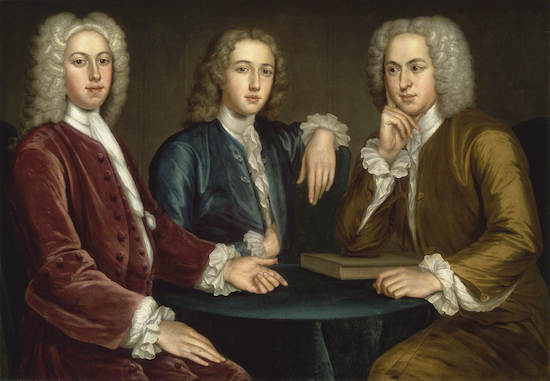 |
| John Smibert, Daniel, Peter, and Andrew Oliver, 1732, oil on canvas, 99.7 x 144.5 cm © 2026 Museum of Fine Arts, Boston (MFAB-159) |
The prosperous merchant Oliver family commissioned 11 portraits from Smibert. This is probably only the second group portrait painted in the colonies up until that time. The first was Smibert's Bermuda Group (1728-1729), a family portrait of a British bishop in Bermuda. That painting established Smibert's format for group portraits, where the sitters are arranged around a table, placed close to the picture plane. Smibert had an innate ability conveying believable poses, moderately individualized features, and the costly yet unremarkable clothing of his sitters far better than any previous colonial painter. In the tradition of European portraits of the elite, Smibert established the sitters' status through their fine clothing and elegant poses, while the far right brother, Andrew, indicates that he was a serious student at Harvard by being shown leaning on a book.
Background
As prosperity increased during the 1700s, the more affluent American colonists wanted to reflect the cultivated taste in painting of their counterparts in Britain. Many1700s painters looked to British painters of the day for stylistic influence.
Most colonial painters were self-taught due to the total absence of art academies. The early colonial style, based largely on prints of English portraits tended to be flat, evenly lit, and rich in realistic detail. Early portraits are characterized by unsophisticated drawing, awkward rendering of anatomy, and emphasis on the luxury items of the sitter.
By 1750, the American style began to change after the first influx of European artists starting as early as the 1720s, mainly from Britain. These academically trained artists were aware of the more current stylistic trends and techniques in painting. They also brought with them a group of stock poses and attitudes in portraiture. Another factor was the rise in the number of American-born artists. The late Baroque style was enthusiastically embraced by the more sophisticated colonial patrons. The American colonial style reached its height between 1750 and 1775, a combination of London-trained painters or American artists who had studied in Britain, with the American fondness for unswerving realism.
Born in Scotland, John Smibert was trained as a painter in London, and studied art three years in Italy. Like many other British painters of his day, he worked in the Baroque style of the most popular British painter of the day, Godfrey Kneller (1646-1723). The style was a formula for sophisticated, idealized portraits of the nobility.
Opening a portrait studio in London in 1722, Smibert was dissatisfied with the amount of competition. He opted to emigrate to the New World in hopes of teaching at a school in Bermuda. When that fell through, Smibert moved to Boston and opened the first professional artist’s studio in New England.
In Smibert’s Boston studio, he proudly displayed his portrait work, including the first group portrait ever seen in the colonies. Wealthy Bostonians were impressed by his renditions of fashionable British nobility and eagerly commissioned portraits from him that would demonstrate their prosperity and fashionable good taste.
Before he retired in 1746, Smibert produced over 250 portraits, and can be considered the first successful professional artist in the United States. He was also the first artist in the colonies to hold a solo exhibition of his work in 1730 in Boston. That show included copies of master paintings he had done while in Italy.
Correlations to Davis program: Davis Collections -- American Colonial Art 1600s-1775

Comments