Artist Birthday: Jimoh Buraimoh (born 1943 Nigeria)
In the early 1900s, Western artists became fascinated by African art, and the potential to use it as a springboard to abstraction. To the present day, there are many African artists who have continue to make major contributions to the development of abstraction in contemporary world art. Jimoh Buraimoh has been a major force in African modernism since the 1960s
Artist Birthday for 3 April: Jimoh Buraimoh (born 1943 Nigeria)
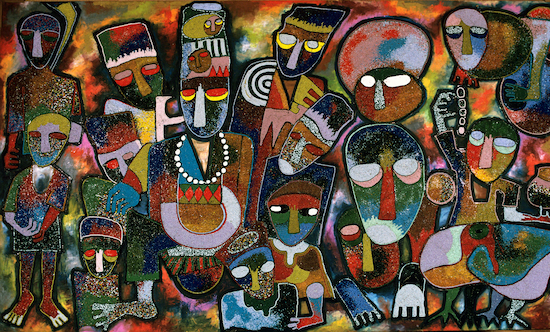 |
| Jimoh Buraimoh, Yoruba Creation, 1972, oil and beadwork on wood © 2026 Jimoh Buraimoh (8s-8803) |
This painting is most likely a depiction of the traditional Yoruban creation story. Obatala, an orisha (spiritual being) was granted permission to create dry land for humans to live on. He took with him a chicken (lower right) to scratch the sand out to create the land, and then planted a palm nut, which grew into the first human. The figure wearing the beaded necklace is most likely Olorun, ruler of the Heavens, who is surrounded by other orishas, including Obatala, who is standing behind the chicken, holding the gold chain on which he descended from heaven.
The forms in Chief Jimoh Buraimoh’s paintings reflect the influence of Yoruban sculpture and mask traditions. Similar forms influenced European artists in the early 1900s as they explored abstraction. The artist has successfully managed to capture the essence of traditional art and translate it into the two-dimensional painting medium.
Buraimoh’s first experimentation while studying art in Oshogbo involved adding beads as inlay into tiles for mosaic tables and plaques. He later carried over his beadwork into his painting. The artist strings beads on cotton thread and glues them to the surface of a board. When placed close together on a flat surface, the beads create raised areas, a variety of shapes, and the illusion of depth. Buraimoh has stated that the influence for his beadwork comes from traditional beaded Yoruba crowns.
Background
Nigerian modern art after independence can be divided into four categories based on form and content -- (1) realistic images of experiences and ideas; (2) folk visions; (3) abstractions; and (4) revisitations and adaptations of traditional art forms. Nigeria has become a country noted for its art, both ancient and modern. Contemporary artists of Nigeria enjoy some of the success and status of ancient artists, producing a variety of works in artistic styles that garner international attention.
One of the major schools of modern art in Nigeria during the late 1900s was in the city of Oshogbo, a major center in the heart of the Yoruban kingdom. Artists of the Osogbo school were influenced by traditional Yoruba mythology and culture. Other artists from the Oshogbo School besides Jimoh Buraimoh, include Prince Twins Seven-Seven (1944-2011), Yinka Adeyemi (born 1941), Asiru Olatunde (1918-1993), and Rufus Ogundele (1946-1996).
Born in Osogbo, Buraimoh’s early life was shaped by his mother, a raffia weaver, which may have instilled in him the skills needed for his future artistic endeavors. He began his working life as a lighting technician for the Duro Ladipo theatre group, where he initially saw the Mbari Mbayo Experimental Art Workshop as a means to perhaps improve his backdrop painting skills for the theater. However, the workshop, organized by Ulli and Georgina Beier in 1964, unlocked a latent desire for visual expression in him.
The Mbari Mbayo workshop allowed Buraimoh to explore various artistic techniques, including oil painting and lino print.. He started experimenting with beads, a material traditionally used in Yoruba design to embellish headgear, stools, and other objects. Unlike his predecessors, Buraimoh reconfigured these beads into contemporary art forms, creating vibrant, intricate artworks.
Buraimoh’s bead artworks combine oil painting and bead inlay to create pieces that are both profound and playful. His innovative approach earned him his first exhibition organized by the Goethe Institute in Lagos in 1967. In 1972, he represented Nigerian artists at the First All African Trade Fair in Nairobi, Kenya, where his artistic vision reached an international audience.
Correlation to Davis program: Experience Art, Unit 1 lesson 1.3

Comments