
Artist Birthday: Hans Wegner (1914-2007 Denmark)
When thinking about the impact Scandinavian modernism had on furniture design, it is impossible to not consider the work of Hans Wegner. He was a prolific designer of all types of chairs, many of which are still produced to this day. During his lifetime he was called the “king of chairs.”
Artist Birthday for 2 April: Hans Wegner (1914-2007 Denmark)
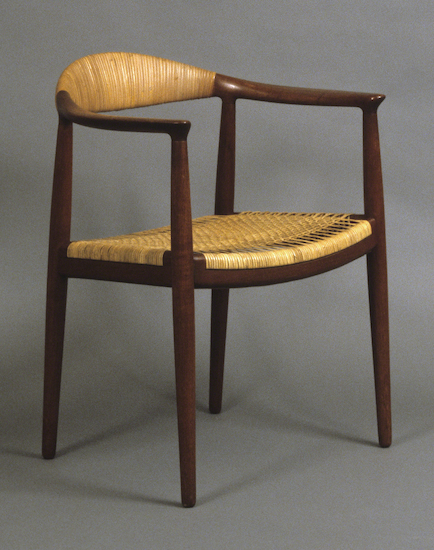 |
| Hans Wegner design for Johannes Hansen Workshop (1940s-1980s, Copenhagen), The Chair, also known as The Kennedy Chair, 1949, teak and split cane, 76.7 x 62.9 x 50.8 cm Cleveland Museum of Art, © 2026 Artist or Estate of Artist (CL-497) |
The Chair was introduced to the public at the Copenhagen Cabinetmakers’ Guild Furniture Exhibition. It is made of solid wood (commonly teak or oak) and features a rounded top rail and woven seat. One of its defining characteristics is its curved back rest that seamlessly combines form and function. While The Chair is organic and minimalist in design it features Wegner’s typical attention to detail of carving and joining of the elements. The Chair gained fame in the United States when it was used in the 1960 televised presidential debates between Richard Nixon and John F. Kennedy. After this exposure, it became extremely popular and was often referred to as The Kennedy Chair.
Background
The history of furniture is defined by forms that have accommodated the human body through the many vicissitudes of fashion and what is fashionable, impacted also by concurrent trends in painting, sculpture and architecture. In essence, furniture is an excellent gauge of what has happened in history, socially, and artistically. The rapid industrialization of Western Europe and the United States during the late 1800s and early 1900s had a major impact on, at first, the mass production of furniture, and later on the style of furniture. The combination of aesthetic integrity and industrial design that emerged in the early decades of the 1900s -- in such schools as the Bauhaus in Germany in 1919 -- engendered the re-magining of utilitarian (decorative) arts as fine art.
As the 1900s progressed, particularly after industrial and technological innovations emerged from World War II (1939-1945), furniture was less about the conformity to the human body and to accepted (particularly the nagging, omnipresent historicist) styles, and more about being a reflection of a modern, industrial, progressive society that combined aesthetics with contemporary technological advances. . With that in mind, many furniture artists use their furniture designs in much the same ways as many contemporary painters or sculptors, as avenues of personal expression, regardless of what is the current trend.
The study of modern furniture is incomplete without looking at the contributions made by Scandinavian artists. These artists found ways to fulfill the demands of modern life in aesthetically beautiful design that run the gamut from finely handmade wooden furniture to completely industrialized works in metal, laminates and plastics. Denmark's Royal Academy of Fine Arts was founded in 1924 to encourage the development of Danish modern design. The school taught on the premise that the foundation for modern furniture must be an understanding of classic furniture construction. Since the 1950s Denmark has been preeminent.
Hans Wegner was born in Tønder, Denmark, the son of a shoemaker. As a child he showed an interest in craft, producing wood carvings of Royal Copenhagen figurines he had seen in the local museum. Starting at age 14, he apprenticed as a furniture maker, producing his first chair at age 15. He moved to Copenhagen at 18 where he studied at the School of Arts and Crafts from 1936 to 1938. While still studying he began his first experiments with chair design. He debuted at the Copenhagen Cabinetmakers’ Guild exhibition in 1938.
In 1938 Wegner worked for architects and designers Aarne Jacobsen (1902-1971) and Erik Møller (1909-2002) where he was given the job of designing furniture for the new Aarhus City Hall (1939-1942). During this same period (around 1940), he began designing furniture for Johannes Hansen’s (1886-1961) company. Hansen was a leading designer of modernist furniture. In 1943 Wegner established his own studio. He was keen to focus on designing chairs. While he made tons of excellent furniture in his career, he particularly made his mark in designing a wide range (over 500 different designs) of chairs. Many of his chair designs are made to this day.

Comments