Artist Birthday: Giovanni Battista Tiepolo (1696-1770 Italy)
Giovanni Battista Tiepolo was a Venetian Rococo/Late Baroque painter who reinvigorated Venetian painting. He was most renowned in his time for his ambitious frescoes with which he decorated churches and palaces alike.
Artist Birthday for 5 March: Giovanni Battista Tiepolo (1696-1770 Italy)
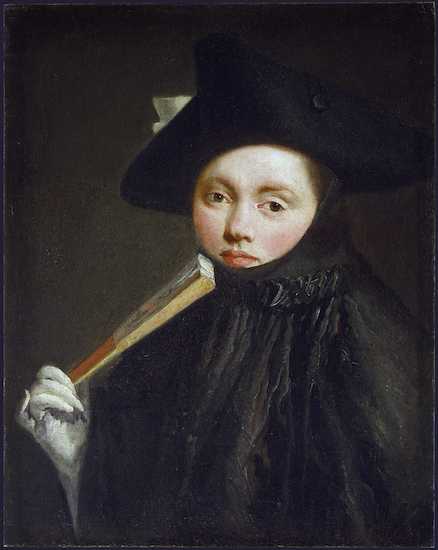 |
| Giovanni Battista Tiepolo, Young Woman in a Tricorn Hat, ca. 1755/1760, oil on canvas, 62.2 x 49.3 cm Image © 2026 National Gallery of Art, Washington (NGA-P0754) |
Even though Rome had assumed the forefront of the Baroque period in Art in Italy during the 1600s, Italian cities still held a thrall for wealthy foreigners -- particularly the British elite -- after the advent of what was called "the Grand Tour", a long sojourn to spots in Italy that conjured up romantic visions of the Italian Renaissance, and even ancient Rome. Young Woman in a Tricorn Hat is likely part of the "half-length figures of women done as a capriccio (a fashionable, whimsical piece of music or art) for the empress of Moscow" described by a Venetian nobleman in a letter from 1760. As this letter suggests, the appeal of these fantasy portraits lies in the exotic, Venetian types featured.
Of particular interest to northern European tourists of the Grand Tour was the intriguing Venetian custom of mask-wearing, which, by the 1700s was restricted to the three-month period between the end of December and the beginning of the Christian season of Lent. Mask-wearing allowed women to dress like men, social classes to mingle, and all types of vulgar behavior that could not be prosecuted because of the anonymity of mask-wearing. Tiepolo presents the typically idealized, generalized features of the "ideal woman", a staple of Rococo painting. Tiepolo depicted her with her mask enticingly pulled down to reveal her face, otherwise swathed all round in black.
Background
The diminishing of the high Baroque style in the early 1700s, replaced with a more relaxed, sensual, and energetically elegant Rococo style had impact throughout most of Europe. In Italy, it was tempered by a continuation of Baroque drama due to the continued reliance of artists on religious commissions.
However, elements of the Rococo style transferred to the Baroque idiom produced an impetus to the evolution of the Grand Manner, a stylistic obsession that flourished in the late 1700s. Italian Rococo displayed many hallmarks of the French Rococo: the use of fantasy and caprice, a grandiose sense of drama bordering on the theatrical, and the higher value palette.
Giovanni Battista Tiepolo was a Venetian artist who achieved a Europe-wide renown, primarily for his fresco decorations of architecture. Trained by an eclectic late-Baroque style artist in Venice from whose studied manner he quickly digressed, he was more influenced by his contemporaries Piazzetta, Canaletto and Guardi, who reintroduced luminosity into Venetian painting. Tiepolo was also influenced also by the Venetian Renaissance masters Tintoretto and Veronese, mostly compositionally. He became acquainted with the Rococo style in the 1720s, and introduced a higher value palette to his work in order to heighten the effect of atmosphere.

Comments