Artist Birthday: Georges Mathieu (1921-2012 France)
After producing paintings that were copies of postcard views, Georges Mathieu went through what he called his "limbo" period (1944-1946), a time when he developed a completely personal new pictorial language. He wondered if it was possible to express in painting without going through the intermediary of representation. With no transition at all, he went from representation to completely abstract works.
Artist Birthday for 27 January: Georges Mathieu (1921-2012 France)
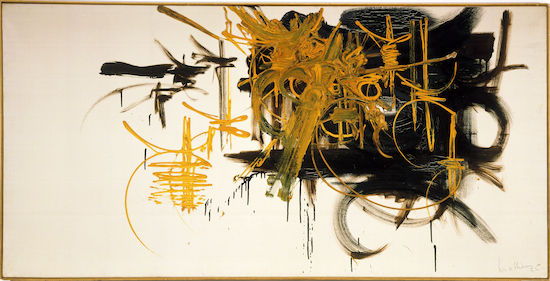 |
| Georges Mathieu, For a Definitive Alienation of Logos, 1955, oil on canvas, 96.5 x 195.6 cm Courtesy the Buffalo AKG Art Museum, Buffalo, NY, © 2026 Estate of Georges Mathieu / Artists Rights Society (ARS), New York (AK-328mthars) |
After Mathieu’s self-proclaimed “limbo period”, Mathieu altered his calligraphy-like abstractions to consist of sweeping patterns of lines squeezed directly from the tube in slashing, impulsive gestures. For Mathieu, speed of execution was essential for intuitive spontaneity. He believed he was placing the work of art in the guises of object, the act, and behavior. He was the first artist to organize performances to see his live painting, as early as 1954. In one performance, he action-painted a 12 x 4 meters canvas using up to 800 tubes of paint. He never used the word performance, because he rejected the notion that his art was purely conceptual, resulting in no object. He insisted that the action had to result in a work of art. His live painting sessions prefigured the Happenings and Performance Art of the late 1950s and 1960s.
Background
In post-World War II (1939-1945) Paris, there was a rise in interest among a group of artists in abstraction that was not dogged by a philosophy or canon, such as the pre-war styles of De Stijl, Constructivism and Suprematism which had dominated European aesthetic through the Bauhaus. These artists sought pure abstraction that was spontaneous, intuitive and guided by emotion. It coincided with similar developments at the same time in the US with Abstract Expressionism.
A French critic gave the movement the name l'Art Informel (Formless Art), and yet another Tachisme, related to the French word tacher which means "to stain or drip. Tachisme referred specifically to the French version of "action painting." Like Abstract Expressionist painters of the same genre, these artists emphasized a lively surface, gestural brush work, and generally automatist creation. The artists of l'Art Informel worked in various types of totally non-objective abstraction.
Georges Mathieu was born in Boulogne-sur-Mer, France. At age 12, he moved to Versailles where he studied Greek, Russian and Spanish. Although he entered law school in 1941, he began a career in art in 1942, being totally self-taught. His earliest works were landscapes and portraits.
Mathieu began working in abstraction at an early point in his career. His early abstractions were experiments with drip techniques, consisting of amorphous shapes. In 1947 he moved to Paris where he was attracted to artists working in Lyrical Abstraction, a form of abstraction that rejected the strict geometry of pre-World War II (1939-1945) painting styles such as De Stijl, Constructivism, and Cubism. Lyrical Abstraction became part of the Art Informel movement, which Mathieu ultimately was part of.
Around 1950, Mathieu began a calligraphic, gestural style, often squeezing paint directly from the tube, emphasizing the necessity of rapid execution in order to harness an intuitive expression. Naturally, he was one of the first European avant-garde artists to recognize the importance of Abstract Expressionism, which was considered a kindred movement to Art Informel. On several occasions, he executed large canvases in front of an audience, while dressed in costume. His work was shown in the 1951 exhibition in Paris called Opposing Forces, which visually contrasted Art Informel with Abstract Expressionism.

Comments