
Artist Birthday: George Caleb Bingham (1811-1879 US)
After portraiture had dominated the subject matter of colonial, and early American painting, genre scenes, still life, and landscape subjects all asserted importance in the early 1800s.George Caleb Bingham is considered one of the first artists to emphasize genre scenes in his body of work, and as such, his paintings are valuable documents of the early days of the country.
Artist Birthday for 20 March: George Caleb Bingham (1811-1879 US)
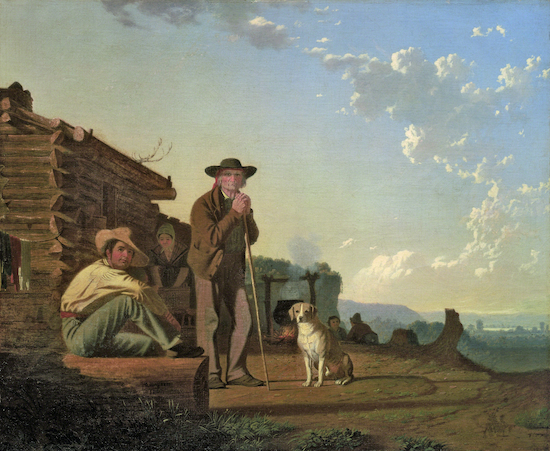 |
| George Caleb Bingham, Squatters, 1850, oil on canvas, 58.7 x 71.8 cm © 2026 Museum of Fine Arts, Boston (MFAB-216) |
Bingham's genre scenes are much closer in spirit to the romantic-realist style of the Hudson River School than to that of the French Realists of the same period. His characters are not mere records of fact, but rather were intended to elicit a respect and empathy for the vital function they served in the new nation. His depiction of squatters on the Western frontier, if not born of admiration, was done with understanding.
Squatters were, after all, illegally set up on land they did not own, were not farmers, and moved on when game got scarce. They sold their land to a second group of settlers who established farms and communities. Bingham, although self-taught, established a strong, pyramidal composition of the main figure group, a technique exploited by Renaissance artists as the basis of strong composition. The scene is bathed in the golden light of a fertile river valley, one of the attractions of the far West to Easterners, despite the humble abode depicted here.
Background
Through the first decade of the 1800s, portraiture was the dominant subject matter in American painting. With victory in both the Revolution and War of 1812, American tastes in art patronage expanded to include subject matter that reflected the affluence and beauty of their new country. Landscapes, still life and genre all rose in popularity with middle class art patrons.
Genre painting -- the depiction of everyday life and labor -- was explored tentatively in the 1790s, and flowered during the 1820s. American genre painting reflected the diversity of its audience. Genre artists sometimes rendered an idealized version of the US as a nation without conflicts, class divisions or industrial disruptions, but realism was also used to render public or private opinions or observations.
George Caleb Bingham was one of America's first important painters to specialize in genre paintings. He was born in Virginia, but his family emigrated to Missouri when he was seven. He showed a propensity for drawing as a young person, which his parents encouraged. When he was nine he met the Romantic-Realist portrait painter Chester Harding (1792-1866) and watched the artist paint portraits in his make-shift studio.
At sixteen, Bingham worked with a cabinetmaker in Booneville and at the same time painted portraits. By 1833 Bingham was earning his living as a portrait painter. In 1838, craving more professional training, Bingham went to Philadelphia and New York for training, and he studied the work of other artists. He was impressed by the work of genre artists.
After returning to Missouri in 1840, Bingham turned his attention to painting the life and labors of Missouri. Having had a keen interest in politics since he was a teenager, Bingham's work often documented political campaigns and elections. These are among his most important historical documents after his images of frontier life. He knew at first hand the life of the frontier, especially the comings and goings of the boatmen who ferried cargo on the great rivers of the Midwest.
Bingham's paintings were intended for audiences in eastern cities such as New York and Philadelphia, and the frontiersmen he portrayed were already by the 1850s emblematic of the hardy characters who were expanding America westward. Pictures like this depicted a new kind of folk hero, unknown in Europe. Like Dutch Baroque genre painters, Bingham's figures are unvarnished documents of genuine individuals whose hard living -- including smoking and drinking -- are is never glossed over. The dignity with which Bingham endowed his characters has prompted some art historians to dub his style "Missouri Classicism."
Correlation to Davis program: A Community Connection 2E, lesson 4.4

Comments