Artist Birthday for: Clarence Carter (1904-2000 US)
Clarence Holbrook Carter was a painter primarily known for his depictions of American life in the period between world wars (1918-1940). He is particularly well known for his riveting views of rural America during the period of the Great Depression (1929-1940), a severe world-wide economic downturn.
Artist Birthday for 26 March: Clarence Carter (1904-2000 US)
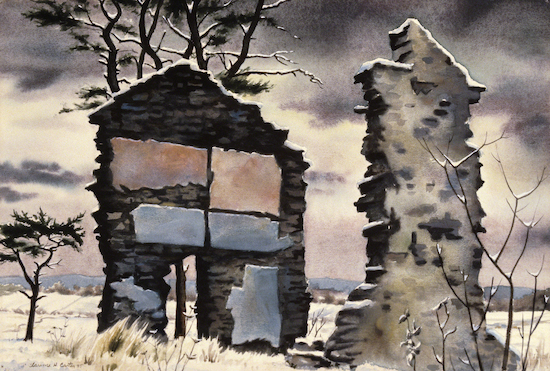 |
| Clarence Carter, Bucks County Ruins, 1945, watercolor on paper Cleveland Museum of Art, © 2026 Artist or Estate of Artist (CL-521) |
Carter, his wife and children moved to Holicong in Bucks County, Pennsylvania in 1944 and 1948. He was searching for new surroundings after teaching at the Carnegie Institute in Pittsburg (1938-1944). Bucks County afforded him many views of dilapidated towns and buildings, large stretches of open country, and images of the life of struggling country people.
He painted this image of Bucks County ruins with precise realist line but included a strong psychological component. He believed that no art could exist without some mystery or awe. Like the paintings of Roman ruins by the late Baroque classicist Giovanni Paolo Panini (1695-1765), Carter endows these ruins with monumentality and dignity. Many of his works feature structures devoid of human presence. Likewise, many of his figural works present personages moving away or with their backs turned to the viewer. There is a stark beauty in this relentless objectivity.
Background
Clarence Carter’s work combined the romantic realism of Edward Hopper (1883-1962) with the empathy for the dignity and integrity of the common person seen in the work of Isabel Bishop (1902-1988). His work neither depresses the viewer with the degradation of poverty during the Depression, nor does it over-romanticize it. In the end, Carter’s work creates a dignified monumentality that expresses the enduring spirit of Americans.
Carter was born in the Ohio River Valley in southern Ohio, a region that informed his painting throughout the 1930s and 1940s. He studied at the Cleveland School of Art, and later for a summer under Hans Hofmann (1880-1966, mentor of the Abstract Expressionists). Even after he eventually left Ohio, his vision remained influenced by his upbringing there.
Through those two decades, Carter’s work was primarily a depiction of the common people and the effects of the Depression upon them. Although it was not sentimentalized, his work did show the plight of the common people in unflinching realism tinged with a somewhat surreal aspect.

Comments