Artist Birthday for 13 March: Maximilien Luce (1858-1941 France)
Maximilien Luce was an Post-Impressionist/Neo-Impressionist painter who most likely was the most dedicated to the Pointillist technique of broken color. After about 1920 he adopted a less strict Pointillist approach that resembled the broken color brush work of Claude Monet (1840-1926)
Artist Birthday for 13 March: Maximilien Luce (1858-1941 France)
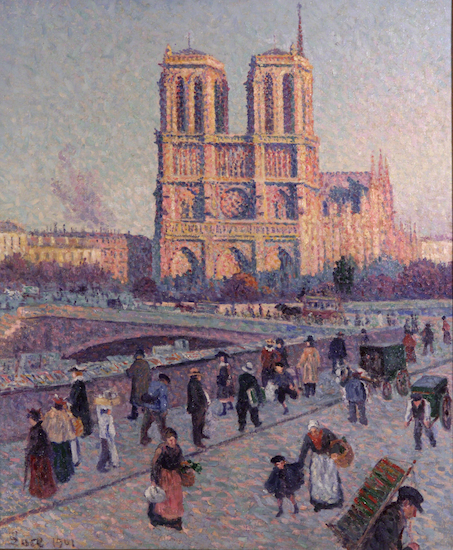 |
| Maximilien Luce, Quai Saint-Michel and Notre-Dame, 1901, oil on canvas, 73 x 60 cm, Musée d’Orsay, Paris, Image © 2026 Dr Ron Wiedenhoeft / Saskia, Ltd. (PFF-0686) |
Luce was particularly drawn to painting churches. He produced at least eleven versions of the western façade of Notre-Dame in Paris between 1890 and 1915; these versions differ depending on the time of day and the weather. Most date from the turn of the century, a time when, in reality, Luce had already distanced himself from Neo-Impressionism and Pointillism. This version preserves the memory of pure Neo-Impressionist colors and testifies to the artist's desire to juxtapose the medieval monument with the hustle and bustle of daily life. Although influenced by Monet’s series of views of Rouen Cathedral, he felt that the super close-up in Monet’s paintings did not give an adequate idea of the proportions of the cathedral. Luce's cathedral views seem to be a response to Monet and the expression of his personal conception of a modern urban landscape transformed by Haussmann's developments and dominated by iron and stone.
Background
Like most major art movements grounded in strict theories, Impressionism ran its course as a ground-breaking art movement between the 1870s and the 1880s. By that time, some artists rejected the limited theory of Impressionism which neglected psychological depth and emotional involvement in the work of art. Post-Impressionists rejected the momentary, detached mood of Impressionism which emphasized the technical aspect of the work of art rather than the subject.
The Post-Impressionists reinvested the subject matter with importance, by using it as the focal point of studies in what the very nature of subject and composition should be. Of the many strains of Post-Impressionism, Neo-Impressionism involved a younger group of artists who sought to unite the color and light technical emphasis of Impressionism with a vision grounded in science and the study of optics. In the view of the Neo-Impressionists, the movement was the logical successor to Impressionism.
Maximilien Luce was a Neo-Impressionist painter and printmaker, born in Paris. As a young man, he apprenticed to become an engraver. During that period, engravers were instrumental in illustrating books, magazines and advertising. In 1876 he studied engraving under the academic painter/engraver Eugène Froment (1844-1900). He also studied around 1880 with Realist painter Charles Carolus-Duran (1837-1917) where he received meticulous academic training.
While with Carolus-Duran, he became associated with Impressionist Camille Pissarro (1830-1903), who introduced him to the Neo-Impressionist/Pointillist style. With Pissarro, Georges Seurat (1859-1895) and Paul Signac (1863-1935), Luce helped form the Neo-Impressionist "school". Until about 1920, Luce was a strict adherent to the Pointillist style. His dedication to the technique was transmitted to artists outside of France such as Theo Rysselberghe (1862-1926) of Belgium.
Correlation to Davis program: Davis Collections -- Western Art Style: Pointillism

Comments