Artist Birthday for 12 March: Anish Kapoor
Although in the early 1980s Kapoor’s work was consciously absorbing aspects of Indian culture, in the late 1980s into the 1990s he began to formulate an abstract visual language that transcends the particularities of any one culture.
Artist Birthday for 12 March: Anish Kapoor (born 1954, Britain, born India)
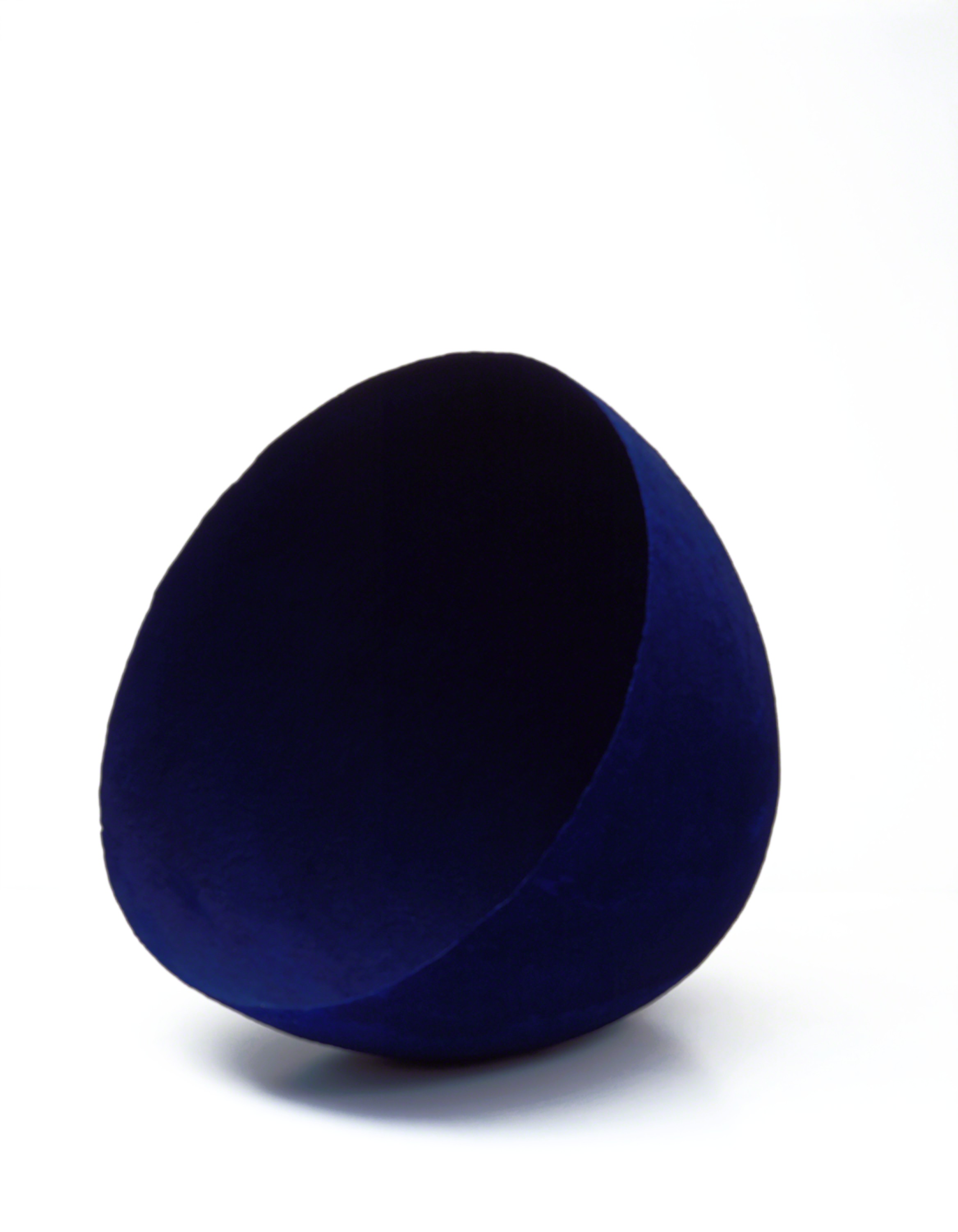 |
| Anish Kapoor, At the Hub of Things, Prussian Blue pigment and polyester resin on polystyrene foam, 160 x 156.2 x 151.8 cm Hirshhorn Museum and Sculpture Garden, Smithsonian Institution, Washington, DC, © Anish Kapoor / Artists Rights Society (ARS), New York (SI-567ankars) |
(Kapoor's faith (Hinduism) was a strong influence in some of his early works. In 1979, Kapoor visited India, where he said that he was impressed by the mounds of ground, colored pigments used in the Hindu spring festival of Holi. Holi celebrates the eternal love of the god Krsna and his beloved consort Radha. The Prussian Blue of At the Hub of Things is significant because the deities of Hinduism are always represented in art with blue skin, blue being a sign of divinity. The festival ultimately is a celebration of good over evil. Covered in Prussian blue, At the Hub of Things appears to be both physical -- the blue of the sky, and spiritual, the blue skin of Hindu gods.
Background
During the 1990s, a new aesthetic emerged in the form of sculpture and installation that drew on the tradition of Process Art from the 1970s. This new emphasis by artists to engaged the viewer with an aesthetic experience also tapped the Women's Art Movement exploration of various type of materials once considered "craft."
The new sculpture was a conscious effort at disengaging sculpture from the Minimalist and Conceptual demand that art contain no hint of narrative. These artists engaged in all sorts of visual, textural and spatial considerations that work together to invest the sculpture with content rather than purely doctrinaire divorcing of meaning from the object.
Anish Kapoor was born in Mumbai, India in 1954 and lives and works in London. He studied at Hornsey College of Art, London, UK (1973–77) followed by postgraduate studies at Chelsea School of Art, London, UK (1977–78). He gained recognition for his site-specific biomorphic sculptures in the 1980s made of limestone, marble and plaster. His early works play with notions of disappearance or partial existence, embodied in his use of ground and powdered materials.
As Kapoor’s works expanded in size, they continued to emphasize the inherent dualities of the material and non-material. Many of his later works embody the perfected finishes of stainless steel or distort through mirrored spaces. His monumental objects border on architectural, and Kapoor has collaborated with architects, engineers and designers throughout his career.

Comments