
Artist Birthday: Fitz Henry Lane
At the same time the Hudson River School was flourishing in the Northeast US, some artists sought to add a spiritual aspect to American landscape painting by concentrating on light and atmosphere. Fitz Hugh Lane was a pioneer of this stylistic interest called Luminism.
Artist Birthday for 18 December: Fitz Henry Lane (1804-1865 US)
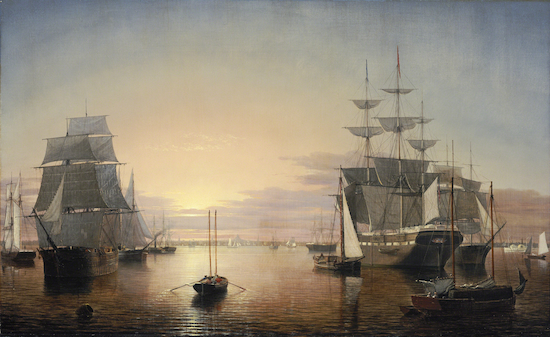 |
| Fitz Henry Lane, Boston Harbor, 1850-1855, oil on canvas, 66 x 106.7 cm Image © 2025 Museum of Fine Arts, Boston (MFAB-204) |
Lane perfected a style characterized by carefully balanced and carefully ordered compositions with radiant effects of light and atmosphere. Lane's paintings achieve a crystal clarity by the linear definition of form, particularly in the painting of the ships. All of his forms, which in some cases are mere silhouettes, are rendered in the brilliantly depicted light and atmosphere, the result of Lane's painstaking process to achieve microscopic nuances of color. These works achieve a transcendental mood akin to the odes to nature written by the likes of Henry David Thoreau (1817-1862).
In Boston Harbor, he successfully merges the essence of a spiritual bond between land, water, sky and humans. It is unavoidable in comparing the essence of Lane's seascapes with ships to those of Dutch Baroque masters who specialized in similar works -- both Lane and the Dutch artists had a special affinity for the sea, and their love and respect for it come out in the details of their works. Lane painted this from a hill in East Boston (where Logan Airport is now located), a popular vantage point often appearing in printed views of Boston at the time. At this time Lane was painting his ambitious scenes of the major Massachusetts ports of Boston, Salem, and Gloucester, which likely appealed to patrons engaged in the shipping industry.
Background
There was virtually no tradition of landscape painting during the 1700s in the US, save for overmantle decoration (a painted woodland scene above a fireplace, usually part of the wall), and as backgrounds in portraits. In the 1800s, after the Revolution, Americans, and Europeans alike came to appreciate the unique and spectacular nature of the American wilderness. After 1825 saw the flowering of the landscape as subject matter in American painting.
As Americans cleared the wilderness and tilled it for farms, constructed canals to increase commerce, and exploited the land for growing industrialization, Americans became nostalgic for what they knew they were slowly losing -- their unique wilderness. Authors and artists began to create romantic reminiscences of the American landscape before the Industrial Revolution. The movement now called the Hudson River School came to embody the ideals sought by Americans in views of their country. It is so named because many of the artists did landscapes up and down the length of the Hudson River in New York.
The American school of landscape painting grew rapidly in the 1840s and 1850s. Luminism was a characteristic of some American landscape painting of that period. It involved the depiction of light and atmosphere that was considered uniquely American. It is no wonder that many Luminist landscapes have subject matter involving a body of water.
Fitz Hugh Lane, born Samuel Rogers Lane in Gloucester, was the son of a sailmaker. He legally changed his name in 1831. Lane learned the fundamentals of drawing while in his teens, and briefly (1832) worked in a lithographic business in Gloucester. Later that year he moved to Boston for formal training and apprenticeship at another lithographic firm. He produced illustrations for sheet music and scenic views until 1837.
In Boston, Lane saw the work of British-born painter Robert Salmon (1775-1845), who was the premier painter at the time of seascapes and harbor scenes full of ships. Lane's early style was decidedly influenced by Salmon's detailed ships and effects of light and atmosphere. By 1840 he had produced his first oil paintings, and by 1842 he was advertised in Boston as a "marine painter." By the mid-1840s, he had established a routine body of work that included landscapes, harbor views, and ship portraits. In 1848 he moved permanently to Gloucester. His style reached its maturity in the early 1850s, with Gloucester, Cape Ann and the coast of Maine the center of his body of work.

Comments