Artist Birthday: Fernand Léger (1881-1955 France)
The art movement called Cubism -- which incorporated the element of time -- was developed by Pablo Picasso (1881-1973) and Georges Braque (1882-1963) around 1908. While Picasso and Braque moved on to other iterations of modernism, many artists, like painter/sculptor Fernand Léger worked in one form of Cubism or another their entire careers.
Artist Birthday for 4 February: Fernand Léger (1881-1955 France)
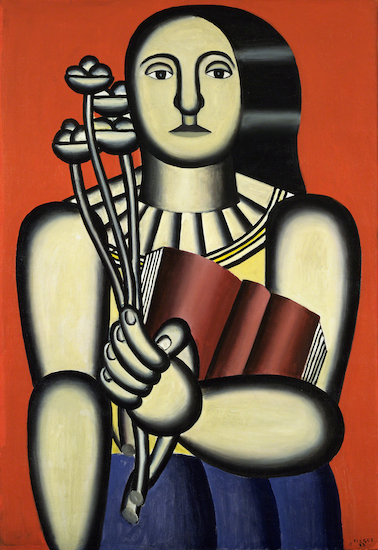 |
| Fernand Léger, Woman with a Book, 1923, oil on canvas, 116 x 81.4 cm Image courtesy of The Museum of Modern Art, New York, © 2026 Artists Rights Society (ARS), New York (MOMA-P1872lgars) |
Unlike the Cubism of Picasso and Braque, Léger's works of the 1920s feature a preference for imitation of metallic, sculptural form. Léger declared that he had broken down the human body, and set about to put it back together. The smooth surfaces of this volumetric woman, bunch of flowers, and book evoke mechanical parts assembled together. The metallic sheen and tight geometry are stylistic treatments that recur in many of Léger’s paintings of this period.
Background
As early as the 1890s, Paul Cézanne (1839-1906), a French post-Impressionist, was searching for a new vision of pictorial space in painting based on simplified, basic geometric forms of the cube, cone and sphere or cylinder, rather than on directly observed nature, the realm of Impressionism. In his late work he defined form by faceted, simplified shapes in which cool and warm colors defined shadow and highlight.
Cézanne had introduced multiple vantage points in a single composition, although the depiction was of a particular moment. Pablo Picasso (1881-1973) went further by depicting multiple vantage points at different times, using overlapping and intersecting planes within the same work. By rearranging the different elements of a figure, landscape or still life to create fragmented, barely recognizable forms, Picasso proposed the painting could be total abstraction, although he himself never went that far in his own work. This experimentation led to the style called Cubism.
Cubism was developed by Picasso in collaboration with Georges Braque (1882-1963), a brief but very intense and highly productive period between 1908 and 1914. Braque’s early advance towards Cubism was characterized by a style closely aligned to the style of the late landscapes of Cézanne: forms reduced to simple volumes with a muted palette. The two artists began to collaborate when they realized their painting was converging on the same point. The stylistic term Cubism was coined by Henri Matisse (1869-1954), who objected that the two artists’ work always seemed to consist of cubes.
Cubism inevitably, and probably unavoidably, was combined by some artists with the modern fascination with machinery and the industrialization of western Europe. Fernand Léger, born into a Normandy family that raised livestock, developed his own personal brand of Cubism that combined the Futurists' interest in modern machine society with the faceted forms of Cézanne. It has been variously called "Tubism" and "Machine Cubism."
Léger initially studied architecture in Caen, and after two years moved to Paris in 1900 where he switched his focus to painting. His earliest painting was a style blending Impressionism and Fauvism. In 1907, after seeing a retrospective of Cézanne's work, and more importantly, the work of Braque and Picasso, his work gradually took on the forms of Cubism. His Cubist vision consisted of a combination of faceted planes and forms built of metallic-looking tubes. This was a literal translation of Cézanne's insistence on the primacy of the cube, pyramid and cylinder.

Comments