Artist Birthday: Esteban Vicente (1903-2001 US, born Spain)
Esteban Vicente was part of the vibrant Abstract Expressionism scene in American art after World War II (1939-1945). His work reflects the type of biomorphic abstraction influenced by Surrealism seen in the works of artists such as Arshile Gorky (1904-1948) and William Baziotes (1912-1963).
Artist Birthday for 20 January: Esteban Vicente (1903-2001 US, born Spain)
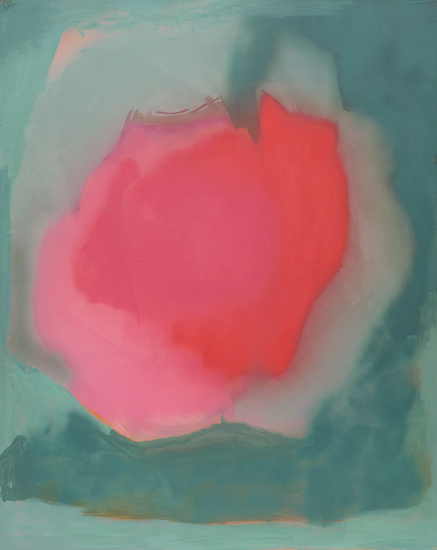 |
| Esteban Vicente, Bridgehampton Rose, 1970, oil on canvas, 152.7 x 122 cm The Museum of Modern Art, New York, © 2026 Artist or Estate of Artist (MOMA-P1128) |
In his works, Vicente explored color, form, and texture in vibrant paintings and inventive collages. Whether using paint or cut-and-torn paper, he crafted his works with painstaking care, attentively layering abstract shapes and varied hues. This was at variance with some of his Abstract Expressionist colleagues who adhered to the idea of spontaneous, automatic creation. In 1950 he established a studio on East 10th Street in the heart of the New York School / Abstract Expressionism artist "colony."
In 1964, he bought an old farm in Bridgehampton, Long Island, where he split his time with the city. Bridgehampton was a refuge for Vicente of wide open fields and extensive flower gardens. Bridgehampton Rose is the closest Vicente ever came to recognizable objects from nature, while maintaining his preference -- honed in the 1960s -- of more reductive approach to vibrant color harmonies and contrasts. This period of work was also marked by thinly applied pigments that defined form by color and light.
Background
Born in Turégano, Spain, Esteban Vicente became an important member of the pioneering American modernism movement Abstract Expressionism. He was raised in Madrid, taken to the Prado Museum as a child by his amateur artist father. In 1921 he enrolled at the Royal Academy of Fine Arts, Madrid, where Salvador Dalí (1904-1989) was a fellow student. He was part of “Generation of ‘27”, a group of avant-garde artists and writers. He also made acquaintance with Pablo Picasso (1881-1973). In 1928 he had his first exhibition in Madrid, and in 1936 he moved permanently to the US to Bridgehampton, NY (Long Island).
In the 1930s and 1940s, Vicente exhibited in New York and Philadelphia. By the late 1940s he became part of the evolving Abstract Expressionist group of artists, associating in “The Club”, the meeting place on East 8th Street in the Village where Abstract Expressionists (mostly male) hung out, discussed art and socialized, which included Jackson Pollock (1912-1956), Franz Kline (1910-1962), Mark Rothko (1903-1970), and Barnett Newman (1905-1970), the “star artists” of Abstract Expressionism. He also shared a studio with Willem de Kooning (1904-1997). He participated in the pivotal “Ninth Street” exhibition of 1951 that cemented Abstract Expressionism as an American art canon.
Vicente taught for much of his career. He was a member of the faculty of Black Mountain College in North Carolina, the New York Studio School, the U of C Berkeley, Princeton University, and the Honolulu Academy of Fine Arts. In 1998 he was honored with the establishment of the Museo de Arte Contemporáneo Esteban Vicente in Segovia, Spain.

Comments