
Artist Birthday: Elihu Vedder (1836-1923 US)
The American painter Elihu Vedder is remembered primarily for his Symbolist style of painting, which emphasized Gothic and Romantic fantasy. His early work was soundly within the mid-century Realism movement.
Artist Birthday for 26 February: Elihu Vedder (1836-1923 US)
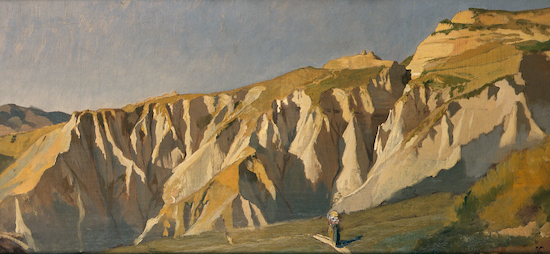 |
| Elihu Vedder, Cliffs of Volterra, 1860, oil on panel, 30 x 64 cm Image © 2026 Butler Institute of American Art, Youngstown, Ohio (BIAA-83) |
In touring the Italian countryside, Vedder came to realize that for him the art in Italy was the answer to his personal search for unique expression. This landscape of Volterra, an ancient Etruscan city southwest of Florence shows how Vedder's association with the Macchiaioli introduced the narrow, horizontal format to landscape that would be seen even as backgrounds in figure subjects. The spotlight effect of the sun on the alabaster cliffs would also play an important part in his painting, even when he in the late 1860s turned to subject influenced by literature of the supernatural or exotic. For Vedder an emphasis on perception never clashed with an emphasis on personal fantasy.
Background
Many American artists chose to go to Europe during the 1800s in order to improve their work, and many ended up adapting the prevailing influences on styles of schools in cities such as Munich, Paris and Rome, which were the leading destinations for American painters. Some American expatriates, however, used their European experiences as spring boards for exploring unique personal visions that disregarded then-current styles in favor of symbolism, mysticism and exoticism.
The reliance of personal vision by some artists of the period coincided with artists who rejected what the saw as the degradation of art in the industrial age and who shared the belief that art should exist for the sake of its beauty alone, and need serve no other purpose, didactic, political or religious. This rejection of morality or any other hindrance to pure creation was called Aestheticism.
Like Whistler and Sargent, Elihu Vedder was a true expatriate American artist, who was more European than American. Born in New York City, his first training as a painter was under the conservative genre and historical painter Tompkins H. Matteson (1813-1884). Matteson, an artist who never studied in Europe, had little influence on the formation of Vedder's unique style. Vedder's first visit to Europe was in 1856. He studied briefly in Paris, and then decided that he wanted to learn about the Italian Renaissance, moving to Florence in 1857.
In Florence, Vedder came under the sway of the Macchiaioli painters a group meeting in the late 1850s. Dissatisfied with Italian academic painting, they advocated reinvigorating Italian painting by emulating the bold tonal structures of Baroque artists such as Rembrandt and Caravaggio whose works often featured tenebristic lighting. They believed that spots (macchia in Italian) of light and shadow were the most important elements of a painting. They were also influenced by the Barbizon landscape painters in France. Their emphasis on capturing the true nature of light and shadow by painting outdoors linked them to the French Impressionists of ten years later.

Comments