Artist Birthday: Édouard Manet
Although his realist paintings never approached the point of pure Impressionism, Manet’s work was a great influence on the burgeoning Impressionist artists. He definitely experimented with the effects of light and color in his paintings, an aesthetic that was greatly influenced by the up-and-coming medium of flash photography.
Artist Birthday for 23 January: Édouard Manet (1832-1883 France)
|
||
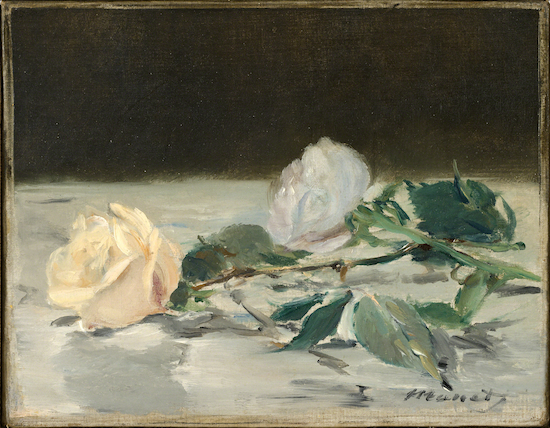
In this late work, the somber blank background of this small still life reflects Manet's earlier palette that had been mostly influenced by Spanish Baroque painting. The neutral background is also typical of Baroque still life works. However, the manner in which he painted these flowers coincides precisely with some that appear in his 1882 renowned work Bar at the Folies Bergère.
Around 1877 Manet's health had begun to deteriorate to the point where he was increasingly unable to paint large canvases. The paintings of his last few years (ca. 1880-1883) reflect this, in their small size and simple compositions, primarily still life. Still evident in these late works, however, is Manet's love of fluid, lively brush work, and large areas of unmodulated color. Like Baroque still life, Manet has focused attention on the foreground picture plane, giving the subject an isolated grandeur to the simple subject in this limited space.
Background
Painting in France in the 1830s and 1840s gradually shifted from an emphasis on the exotic and dramatic of Romanticism to an emphasis on extreme naturalism based on acute observation of nature. This style evolved partly from a sub-group of the Romantic movement known as Pre-Raphaelites.
These were artists who preferred themes from Medieval romances, and stylistically were inclined to artists of the Renaissance before Raphael (1483-1520). The philosopher John Ruskin, in his book "Modern Painting,"(1843), in reference to the Pre-Raphaelites, said that painting had no higher calling than to be absolutely faithful to nature.
Whereas Romanticism relied on naturalistic detail in order to tell a dramatic story, Realism used naturalistic detail to depict everyday life without dramatic or romantic overtones. The popularity of Realism paralleled the rise in prosperity all over Europe of the middle-class, and the evolution of the art form of photography. As a new class of art patrons, they rejected history painting in favor of scenes recognizable from their own lives. This emphasis in realism ultimately spawned Impressionism.
Born the son of a government jurist, Édouard Manet was inclined towards the arts by an uncle who took him on frequent visits to the Louvre museum in Paris. After service in the merchant marine, he studied first under Realist/Barbizon painter Thomas Couture (1815-79), whose academic style dissatisfied him. He studied the works of the Venetian Renaissance masters, and Dutch and Spanish Baroque painting. His earliest paintings reflect the Spanish Baroque influence, especially that of Diego Velázquez (1599-1660), with clear color, strong line and large flat, typically unmodulated areas or pigment.
Manet began his career as a painter at a time in France that witnessed a growth in urbanization in Paris, the extension of railroads, and an optimistic regard for modernization. Manet did not follow academic artists (like Couture) who believed that art was at its highest aesthetic quality when relying on historical forms and formulas.
Instead Manet followed the recommendations of essayist/philosopher Charles Baudelaire (1821-1867), who advised artists to be “painters of modern life.” Already an enthusiast for photography’s ability to freeze a moment in time, Manet began to paint snapshots of urban life in a palette largely based on Baroque art.
Because of his affinity for urban life, Manet became a leader among the younger artists who were experimenting with Impressionism. He was interested in the "spotlight" effect in Baroque painting, as well as in photographic techniques.
Through contact with Impressionists Claude Monet (1840-1926), Auguste Renoir (1841-1919), Alfred Sisley (1839-1899) and Frédéric Bazille (1841-1870), Manet lightened his palette, though he still used black, and preferred to paint in the studio rather than outdoors (en plein air), as the Impressionists did. His fresh approach to everyday life and observation of nature as well as his use of color, broad planes, and solid construction had a great impact on the Impressionists.

Comments