Artist Birthday: Charles Peale Polk (1767-1822 US)
Charles Peale Polk faced a rough childhood when both parents died in the same period, but Polk was fortunate to have a successful artist uncle in Philadelphia, with whom he went to live at the age of 9 or 10. Unlike many of his Peale cousins who went on to become accomplished professional artists (into the 1900s!), Polk’s work never really “caught fire”.
Artist Birthday for 17 March: Charles Peale Polk (1767-1822 US)
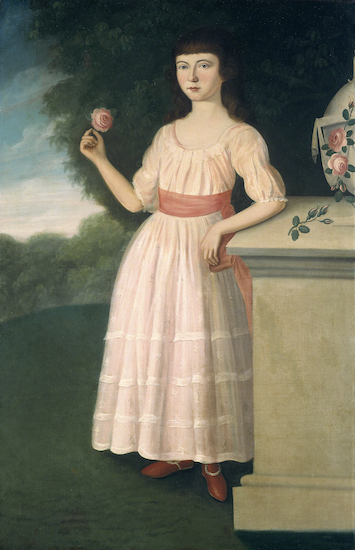 |
| Charles Peale Polk, Anna Maria Cumpston (1780-1859), ca. 1790, oil on canvas, 147 x 95.6 cm Image © 2026 National Gallery of Art, Washington (NGA-P1006) |
Some scholars believe that Charles Peale Polk was one of the teachers of America’s first African American painter of note Joshua Johnson (ca. 1763-after 1826). Their styles are certainly similar as is evidence in this portrait. The subject is evenly lit, against a soft background that does hark back to those in portraits by his uncle. However, the young woman’s face is blank, betraying no personality. She awkwardly holds a flower, while leaning against a ledge with an urn that does not recede naturally in perspective, but betrays two vantage points. In the history of Western European portraiture, portraits of upper class women like Anna Maria Cumpston include symbols of the sitter's status. Holding a pink rose in this portrait, Anna Maria is symbolizing her refined and well-bred station in life. The park-like setting also reflects on the sitter's elite situation, with the implication that she lives in a large house with grounds. Like his uncle, Polk did not have a complete mastery of anatomy, although Polk less so than Charles Willson. There is no evidence of a body underneath the dress, although Polk has paid particular attention to physical details in the dress and the flowers, while the face is a lifeless mask. In many ways, Polk’s portraits are in the same spirit as the self-taught, naïve painters of the period.
Background
Because there were no art academies in the colonies, most colonial painters were self-taught. Training consisted of apprenticeship with established artists, who relied on direct observation rather than knowledge of anatomy. Some native American artists traveled to Britain to learn from British painters. The early colonial style, based largely on prints of British portraits tended to be flat, evenly lit, and rich in realistic detail. Early portraits are characterized by unsophisticated drawing, awkward rendering of anatomy, and emphasis on detail of luxury items of the sitter, including sumptuous clothing.
By 1750, the American style began to change with the first influx of European artists, mainly from Britain. These academically trained artists were aware of the more current stylistic trends and techniques in painting. They also brought with them a group of stock poses and attitudes in portraiture. This, in addition to the more sophisticated taste of American patrons explains why the late Baroque style was so enthusiastically embraced by colonial patrons. Eventually, the European courtly tradition combined with the American fondness for realism to create a distinct American style.
The first great “dynasty” of American painters was overseen by Charles Willson Peale (1741-1827) who was a well-established artist in Philadelphia. Born in Annapolis, Maryland, Charles Peale Polk was the son of Charles Willson’s younger sister Elizabeth Digby Peale (1744-1777), and Robert Polk (1744-1777). At age nine or ten he was orphaned and sent to live with his uncle in Philadelphia. Growing up in Charles Willson’s household meant that Charles received the same education and artistic training as his cousins. His earliest paintings in oil were copies of his uncle’s works which he executed at the age of sixteen.
By eighteen Charles was married and had settled in Philadelphia, although he traveled to Baltimore and Alexandria to seek out painting commissions. Early on he does not seem to have been successful, and in 1787 he advertised for employment as a house, sign or ship painter. Charles’ style, although dependent on the training by his uncle, never achieved the level of sophistication of his uncle’s mature style. He continued to copy Charles Willson’s work, including one of his uncle’s George Washington portraits, of which he made 57 copies.
In 1791 he moved to Maryland where he had considerable success as an artist, producing portraits and making the acquaintance of future presidents James Madison and Thomas Jefferson. He eventually took a job in the Department of the Treasury in Washington and his production of oil portraits went to almost nil. Late in his life he took up farming in Richmond County, Virginia, where he died.

Comments