
Artist Birthday: Catherine Murphy (born 1946 US)
Catherine Murphy follows the cherished American artistic tradition of carefully observed realism in her fabulous, Photorealist paintings. Her aesthetic also transcends countries and time periods, with roots in Northern Renaissance painting and Baroque still life.
Artist Birthday for 22 January: Catherine Murphy (born 1946 US)
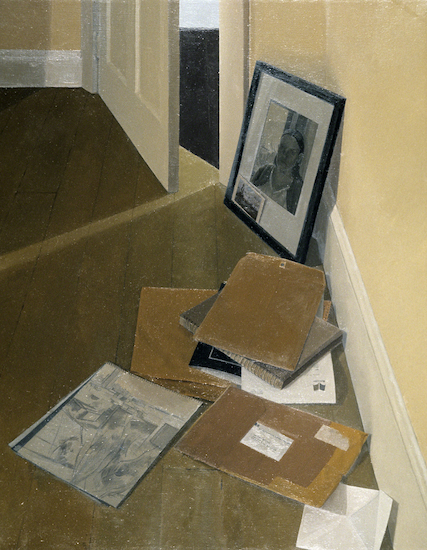 |
| Catherine Murphy, Still Life with Envelopes, 1976, oil on canvas, 71.1 x 55.8 cm The Phillips Collection, © 2026 Catherine Murphy (PC-302) |
Unlike other Photorealist painters, Murphy has not relied on photographs, rather direct observation. Like fellow realist Vija Celmins (born 1938, who does work from photographs), she produces only a few works per year, because of her time-consuming application of layer upon layer of medium. Some of the artist's favorite subjects are envelopes and wrapped packages. Although her works give the air of haphazard placement, they are actually carefully planned to fill the composition. In this Still Life, the angle of the open door is repeated in the scattered envelops, creating a unity along with the reserved palette. There is a succinct addition of a self-portrait, to which the open door draws the eye.
Background
The penchant for an acutely observed brand of realism has been present in all periods of American painting. From the earliest years of the colonies, American art patrons preferred down-to-earth depictions of subject matter with which they were familiar rather than any esoteric, philosophical, romantic or high-toned historical content (unless it glorified US history). Despite the widely held idea that Abstract Expressionism was the "only modern style" in the period after World War II (1939-1945), many artists persisted in stressing realism in their work before it was popular (as in Pop Art, California Figuration, and Photorealism) to rebel against America's first indigenous modernist movement.
One result of the Women's Art Movement of the 1970s was the movement by some women artists to try to identify the formal qualities found universally in women’s art, that have been suppressed in the male dominated art schools and by male art critics. Some of these qualities, set forth by a woman art critic, were obsessive detail and sensuous surfaces and forms. Such tendencies may have been integral in the fact that many women artists turned to realism starting in the early 1970s in order to get their message across. Realism was one of the many styles used by Pop artists to parody American society. In the hands of a woman artist it could make powerful social inferences.
Catherine Murphy was born in Lexington, MA, the daughter of an Irish musician. As a child, the only art Murphy saw was Saturday Evening Post magazine covers, Norman Rockwell (1894-1976) being her favorite illustrator. Her appreciation for his realism arose during a period when the "art world" was ga-ga for Abstract Expressionism.
Murphy studied at the Pratt Institute in Brooklyn from 1963 to 1967. Her mentor, the Russian-American realist Eugene Berman (1899-1972) encouraged her to revere the aesthetics of Renaissance and Baroque realism, trust her own vision, and take time with her work. She has maintained those admonitions throughout her career.
Through the 1970s and 1980s, a large part of Murphy's body of work was portraits and landscapes. While her work has mimicked the realism seen in the super-realistic portraits by the likes of Northern Renaissance masters like Jan van Eyck (1395-1441) or Rogier van der Weyden (1400-1464), her works contain a certain reverie or melancholy that makes her realism rise above the mere copying of a perceived image.

Comments