
Artist Birthday: Burgoyne Diller
Burgoyne Diller was a true pioneer in American abstraction. During the period when Abstraction Expressionism dominated American modernism, Diller quietly pursued geometric abstraction that was influenced by Russian Constructivism, Dutch Neo-Plasticism (De Stijl), and the principles of German abstractionist Hans Hofmann (1880-1966).
Artist Birthday for 13 January: Burgoyne Diller (1906-1965 US)
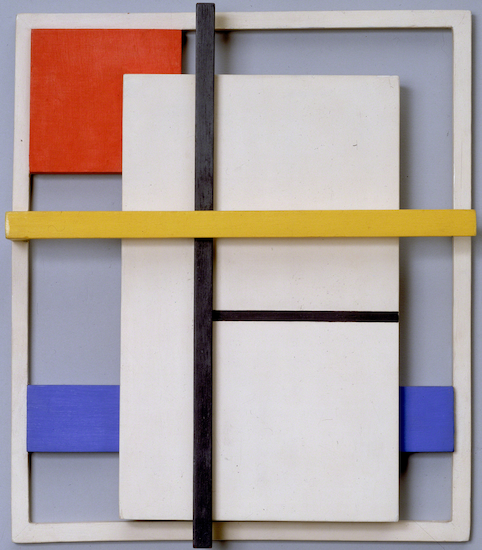 |
| Burgoyne Diller, Construction, 1938, painted wood construction, 37 x 31.9 x 6.7 cm The Museum of Modern Art, New York, © 2026 Estate of Burgoyne Diller / Licensed by VAGA at Artists Rights Society (ARS), New York (MOMA-S0756divg) |
Diller was the first American artist to embrace the strict visual vocabulary of Mondrian’s Neo-Plasticism. The style renounced any naturalistic representation or extraneous embellishment in favor of straight lines, rectangular planes and primary colors. Diller was mostly focused – using similar criteria to Mondrian – to establishing a formal balance, stability and structure. He believed that such reductive abstraction was well-suited to the modern, industrialized world. In Diller's Construction's, the artist was exploring the spatial possibilities of painting. This is probably one of the most Mondrian-like compositions in Diller's body of work.
Background
In the early 1900s, European-influenced modernism spread steadily among American artists who brought it back home after studying abroad. After America’s involvement in the horrors of World War I (1914-1918), however, American artists began to shy away from abstraction and other modernist tendencies, because art patrons viewed anything European-influenced as reminders of the awful war. Abstraction was very low-key in American art from the time of the Great Depression (1929-1940) until after World War II (1945). Americans turned introspective during the Depression, and desired subject matter in art that was uplifting, realistic depictions of American life. Abstract artists were excluded from museum shows and galleries. Critics panned abstraction as “un-American.”
However, some events during the 1920s and 1930s helped keep abstraction alive in America, primarily New York. It included visits by several major avant-garde European artists, the institution at New York University of the Gallery of Living Art, the opening of the Museum of Modern Art in 1929, and the opening of the Guggenheim Museum (then called the Museum of Non-Objective Painting) in 1939. A small group of pioneer abstractionists, however, a great number of whom were women, formed the American Abstract Artists group in 1936 in order to promote abstraction in American art.
Burgoyne Diller was born in the Bronx, New York, but, his family moved to Michigan when he was 13. A childhood illness which kept him out of school for a year was the period when Diller began to draw. Naturally talented in art, after graduating from college in Michigan, he returned to New York to study at the Art Students League (1928-1933), under such notable abstractionists as Hans Hofmann (1880-1966). While there, his painting consisted of volumetric, biomorphic forms floating in a void.
During the Great Depressions (1929-1940), Diller supervised murals for the government’s Works Progress Administration art program. He oversaw 200 murals between 1934 and 1940, many of which were executed by abstract artists he chose such as Stuart Davis (1892-1964). In 1937 he was one of the founding members of the American Abstract Artists group. During the 1930s Diller’s work evolved from Cubism-inspired forms to strict Neo-Plasticism, the style of Piet Mondrian (1872-1944) also called De Stijl. While serving (1943-1945) in the Navy in World War II (1939-1945), Diller did not paint at all.
Diller re-immersed himself in art in 1946, resuming painting, drawing, and sculpture. Although influenced by Mondrian’s drastic reduction of painting forms to squares in primary colors, Diller was able to personalize his Neo-Plasticism, with a series of themes labeled First, Second, and Third. Each series explored forms in movement of forms in constant opposition. He translated these forms into wall-mounted wooden constructions in the 1940s. These sculptures developed into large scale, freestanding sculptures in the 1950s and 1960s

Comments