
Artist Birthday: Asger Jorn (1914-1973 Denmark)
Asger Jorn was a leading painter of the European post-war CoBrA artists group. The CoBrA artists sought to distance European abstraction from its tradition of geometric forms, introducing more expressionistic elements. The CoBrA group has often been compared stylistically to Abstract Expressionism, the post-war American abstract movement
.
Artist Birthday for 3 March: Asger Jorn (1914-1973 Denmark)
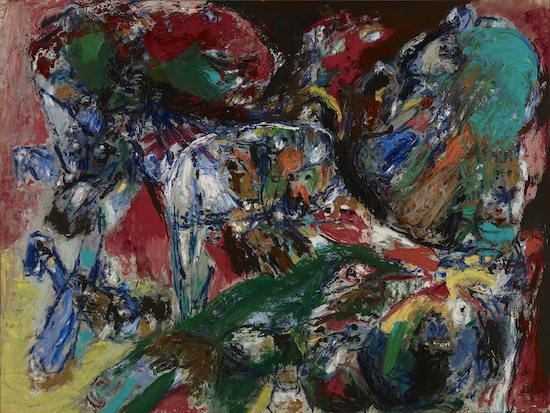 |
| Asger Jorn, Untitled, 1962, oil on canvas, 98.4 x 130.8 cm Buffalo AKG Art Museum, Buffalo, NY, © 2026 Asger Jorn / Artists Rights Society (ARS), New York. (AK-3868joars) |
This untitled work clearly shows Jorn's indebtedness to the biomorphic, abstract forms of Miró and also Surrealist André Masson (1896-1987). Although his works are gestural, non-objective abstraction, Jorn was rooted in representation. Untitled contains several vague references to animals, or birds, and he often was influenced by Nordic Visionary art traditions. Using undiluted, pure color, Jorn smeared and dripped his paint, often applying with gestural, slashing brush stokes. However, like many of the American Abstract Expressionists, he never ignored the borders of the frame, creating closed compositions despite his seemingly frenzied application of medium. He achieved unity and asymmetrical balance with color shapes and dynamic, linear movement.
Background
After World War II (1939-1945), many of the European artists who had fled to America for the period of the war returned there. Many of them continued to pursue abstraction as they had before the war. Others were interested in reviving the exploration of figuration.
This is a repeat of what had happened after World War I (1914-1918), when even some of the major pioneers of abstraction, such as Picasso, had returned to the figure. The duel between abstraction and figuration for primacy continued unabated in Europe after the war.
In the post-war Netherlands, modernist artists finally tired of the geometric, Constructivist abstraction of De Stijl that had dominated art since the 1920s. Three artists, Karel Appel (1921-2006 Neth), George Constant (1920-2005 Neth) and Cornelis Corneille (1922-2010 Bel), established the Experimental Group in 1948. They wanted to explore new forms of expression that rejected both the stale geometry of Piet Mondrian (1872-1944 Neth) and the atrophied academic tradition. The group evolved with artists from Belgium and Denmark to CoBrA (standing for Copenhagen, Brussels and Amsterdam).
Many of the CoBrA artists explored expressionistic figuration, much like the art of Jean Dubuffet (1901-1985 Fr). They too were influenced by the art of Visionary artists. There was no doctrine, save for the idea of unrestrained experimentation. Their work is characterized by emphasis on brush gesture and jarring color.
Asger Jorn was one of the most vehement in his rejection of the serenity and order of geometric abstraction. Born Asger Jörgensen in Vejrum, Denmark, in 1936 he studied in Paris at Fernand Léger's (1881-1955) Contemporary Academy where he learned a solid foundation in painting. During World War II (1939-1945), Jorn stayed in Denmark where his work was influenced by Expressionist James Ensor (1860-1949), abstractionist Vasily Kandinsky (1866-1944), and personal fantasy of Paul Klee (1879-1940). By far the most important influence on his work was the biomorphic abstraction of Joan Miró (1893-1983). That influence would stay with Jorn all his career.
After the war, he had his first solo exhibition in Paris in 1948, where he then became involved with the CoBrA artists. In 1954 he settled in Italy, and thereafter split his time between Paris and Alba, Italy. He also participated in the artists' groups International Movement for Imaginist Bauhaus (1953-1957) which evolved into the International Situationist movement. He also studied Scandanavian Visionary Art, and produced art in the form of illustration, printmaking, ceramics, and towards the end of his life sculpture.

Comments