Artist Birthday: Alice Neel
Alice Neel was a great American portraitist. Her portraits were insightfully realistic, although not to the point of Photorealism, for her works tended to emphasize rich color. The most enduring aspect of her portraits was the empathy that she obviously felt for her sitters.
Artist Birthday for 28 January: Alice Neel (1900-1984 US)
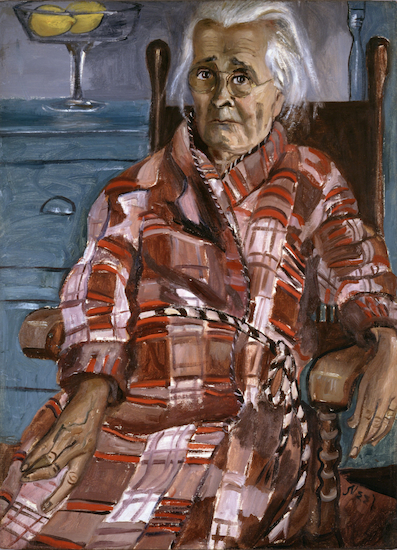 |
| Alice Neel, Last Sickness, 1953, oil on canvas, 76.2 x 55.9 cm Image courtesy of Philadelphia Museum of Art, © 2026 Artist or estate of Artist |
Portraits such as this – of Neel’s mother Alice Hartley Neel (1868-1954) – was one of four Neel painted of her dying mother when they lived together in New York. In it we see emphatically the empathy and compassion Neel brought forth for her sitters, this one only a few months before her mother died in 1954. The loving mother-daughter dynamic is captured brilliantly, and is poignantly rendered public.
The dubious look in her mother’s face did not prevent Neel from showing every nuance of a dying woman, confronting old age head on with dignity. Neel’s rendition of her mother is both frank, and yet sensitive, with no judgment or affectation imposed on the subject, a hallmark of all of her portraits.
Neel's portraits are most famous for her green and violet shadows which give the sitters a monumentality, no matter how casual the pose or outfit. This bravura brush work extends to her mother’s wonderfully rendered bathrobe. The brilliant yellow of the lemons in the background are a contrast to the sitter’s apparent resignation to the realities of time.
Background
Since the late 1900s, the opportunities for women artists to forge careers and exhibit their work have greatly improved. It was facilitated by women artists in the 1970s who boycotted major museums and by individual art historians who wrote articles in scholarly journals. Of the many art movements of the late twentieth century, women have participated fully in all of them. The return to figuration was one of the most vigorous trends in which women artists participated.
For certain women, like Alice Neel, the increased opportunities did not benefit her until late in her life. Born in rural Pennsylvania with harsh parents, Neel knew from an early age that she wanted to be an artist. She studied commercial art at the Philadelphia School of Design for Women and later at the Pennsylvania Academy of Fine Arts, where she mastered painting. The repression of Neel's childhood and her abject poverty gave her portraiture an expressionistic edge that was not well received by either patrons or galleries. This notwithstanding, she received her first one-person show in Havana during a visit with her Cuban husband (the marriage was short lived).
Returning to America, Neel lived a bohemian life as an artist in New York. During the 1930s she survived by working on the WPA art projects. Even there she found work difficult to come by, as the institutions that were supposed to sponsor WPA artists did not like her expressionistic painting style. She did, however, hone her portraiture into the style for which she became renowned for the rest of her career.
Even with the return of figuration in the 1960s, Neel’s work was not widely accepted, and she was pointedly left out of the Museum of Modern Art’s 1962 show “Recent Painting -- USA,” a show that highlighted mostly abstract art. However, noticed by a prominent art critic, she was given her first one-person show in America at the Graham Gallery in New York, which exhibited her work frequently until her death.
Neel ignored modern American movements from Abstract Expressionism through Minimalism and Conceptual Art. She also did not follow the trend of Photorealism which emerged out of Pop Art. Her portraits were not Photorealistic, but she was able to capture the intensity and character of her sitters through her energetic brush work and often lurid color.

Comments