African American History Month: Joseph Yoakum (1890-1972 US)
Self-taught artists are often well into their middle age when they begin to take up their artistic practice. Having reached their middle years, many of them bring to their work valuable practical knowledge and a wide perspective gained from everyday living. Rather than imitate their environment, they prefer to express personal imagery filled with faith and a love of life. Joseph Yoakum was an African American, possibly of Native American descent who was just such a Visionary painter.
Celebrating African American History Month: Joseph Yoakum (1890-1972 US)
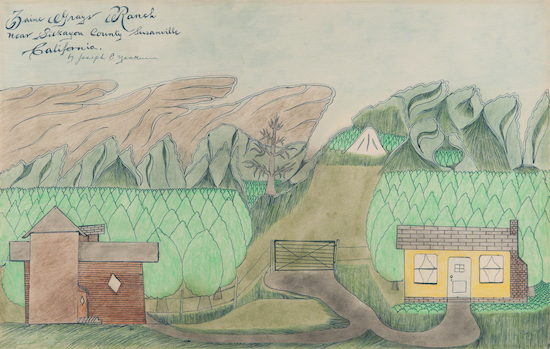 |
| Joseph Yoakum, Zaine Grays (sic) Ranch Near Siskayo County Susanville California, ca. 1968, blue ballpoint pen and colored pencil on paper, 30.6 x 48.4 cm (12” x 19”) Philadelphia Museum of Art, © 2026 Artist or Estate of Artist (PMA-8190) |
Yoakum’s early drawings were executed on small pieces of white or manila paper in pen and pencil with little or no color. Although he enjoyed doing portraits of celebrities drawn from movie magazines, the majority of his works were landscapes. In hundreds of variations, these real or imagined landscapes inevitably involved mountains and water as major themes. Although he named specific places in his drawings, such as mountain ranges or great valleys, the locations are really not identifiable. He may have taken the specific names from the travel books, atlas and encyclopedias he kept.
Yoakum’s consistent use of the imaginary, swirling contour line-defined mountains plastered with a pattern of triangular shapes representing trees are symbolic of his personal view that God and nature were one, reflected in every region of the world. The imaginary, globular forms of his mountains are reminiscent of the soaring, vertically stacked peaks seen in many periods of Chinese landscape works.
Background
There is a long tradition of "folk art" all over the world. Folk art used to be the term that covered a broad range of art produced by people who were self-taught, or had little training in art at all. Folk art is sometimes divided into two genres -- 1) the art of self-trained artists, who, although not producing painting or sculpture in a style that reflects art school training, earn a living with their art; and 2) the art of of those with little or no training whatsoever who produce works of art primarily for the joy of creating.
Such art was deemed "outsider art," implying that it was outside of the "official art world." The term “outsider art” was coined in the 1970s as an English (mis-) translation of the French modernist Jean Dubuffet’s (1901-1985) label Art Brut (French for "Raw Art") for the huge personal collection of such art that he had starting in the 1930s. Much of the art in Dubuffet's collection was produced by artists who were either mentally challenged or physically handicapped.
"Outsider" has now been changed to "Visionary", because many of the visionary artists work from personal spiritual or emotional visions that defy conventional representation. A major tendency in Visionary Art is that the work was usually created with little or no awareness or interest in other trends in art.
Joseph Yoakum was born to a farmer in Window Rock, Arizona. His family moved to Kansas City, Missouri during his childhood and settled eventually on a farm in Walnut Grove. Although the artist claimed he only went to school three or four months, the notations on his drawings suggested exposure to formal schooling. Yoakum maintained vastly different accounts of his background, and claimed that he ran away to work in a circus while a teenager. He also claimed that he had visited all of the places depicted in his drawings.
He served in France during World War I (1914-1918), and subsequently may have visited Europe, Russia, Mexico, the Middle East, Siberia, Canada, Central America and South America, although his whereabouts and activities between his military discharge and beginning of his artistic activities in the 1960s is unknown. According to the artist, he was moved to make art as the result of a dream he had about 1962. He declared that his work was a spiritual enfolding, presumably meaning that his imagery appeared to him as he worked.
Correlations to Davis programs: Explorations in Art 2E grade 1, lesson 4;5; Explorations in Art 2E grade 2, lessons 1.6, 1.8; Explorations in Art 2E grade 3, lessons 2.9, 2.7; Explorations in Art 2E grade 4, lessons 3.1, 4.5; Explorations in Art 2E grade 6, lessons 2.3, 6.4; A Personal Journey 2E, lesson 5.4; The Visual Experience 4E lesson 8.13; Discovering Drawing 3E, pp.94-103; Davis Collections -- Visionary / Folk Art

Comments