African American History Month: James Van Der Zee (1886-1983 US)
The term “Harlem Renaissance” indicates the period between ca. 1918 and 1930 when the Harlem neighborhood of New York experienced a flourishing of African American art, music, and culture. The Harlem Renaissance may have been summed up best in the photographs of that period by photographer James Van Der Zee.
Celebrating African American History Month 2026: Photographer James Van Der Zee (1886-1983 US)
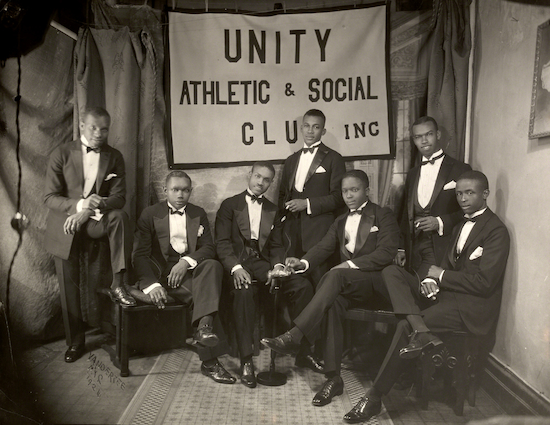 |
| James Van Der Zee, Unity Athletic & Social Club, Inc., 1926, gelatin silver print, 20 x 25.6 cm (7 7/8” x 10”) Image The Museum of Modern Art, New York, © 2026 Artist or Estate of Artist / Donna Mussenden VanDerZee (MOMA-P0646) |
Although Van Der Zee worked predominantly in the studio, he was also an important artist for group portraits. Group portraits such as this involved little artifice, but are invaluable in documenting Harlem society during a period when the section of New York had a flourishing, rising middle-class life. If studied carefully, the viewer can see in this photograph where Van Der Zee scratched lines into the negative to indicate smoke rising from the cigarettes the men hold. Van Der Zee documented hundreds of social clubs, private parties, school graduations, and political events. His consummate skill at posing, lighting and composition are a hallmark of the dignity of the African American community that evolved during the Harlem Renaissance.
He also created funeral photographs between the wars, which showcased the elaborate social functions surrounding such occasions. These were collected in 1978 into the Harlem Book of the Dead. Van Der Zee's photographs paralleled the work of painters during the Harlem Renaissance, showing black people not as downtrodden urban or rural poor, but as sophisticated, beautiful Americans.
Background
Right around the time of World War I (1914–1918), there was a great migration of African Americans from the rural South to cities in the North. Black people looked to big cities in the North with the many industries in the hope of jobs and a good life well into the 1960s.
In cities such as New York, Boston, Chicago, Pittsburgh, Kansas City, and Detroit, industries were expanding because of World War I and there were job opportunities for African Americans. The black populations increased dramatically between 1918 and 1925. Cohesive African American communities formed within the cities, and African Americans found a new self-awareness and pride in their heritage. During the 1920s, a significant number of artists were brought together within these large and varied African American communities.
One of the most dynamic, culturally rich African American communities was in the Harlem neighborhood of New York. The resulting explosion in African American art and culture is called the Harlem Renaissance. Many of the artists of Harlem Renaissance in New York had been born in the South.
James Van Der Zee was born in Lenox, Massachusetts, where he made his first photographs as a boy for a hobby. He also developed skills as a pianist and aspiring violinist. At 14 he received his first camera from a magazine promotion. From a toy camera he upgraded to a better one with which he took hundreds of photos of his town and the people of the town. Because he was only the second person in Lenox to own a camera, he learned to develop the images himself.
After Van Der Zee moved with his father and brother to Harlem in 1906, he gave piano lessons to earn a living and co-founded the five-person Harlem Orchestra. He became a dark room technician for Gertz Department Store in Newark, and substituted as a portrait photographer. He found that the patrons enjoyed the creative way he posed them in their portraits, which encouraged him to open his own studio in 1916. During World War I (1914-1918), VanDerZee honed his craft as a portrait photographer, and became a fabulous success within two years of opening his studio.
The heyday of VanDerZee's portraits of the important artists, philosophers, writers, musicians and actors of Harlem was during the 1920s. Demand was great for his studio portraits, and it encouraged VanDerZee to experiment with complex settings, costumes, dramatic poses, and superimposition of one negative into another. Sitters wanted their portraits modeled on celebrities of the 1920s and 1930s. VanDerZee achieved a level of dramatic, sometimes sentimental tableau vivant that characterized Pictorialist photography from the 1800s. VanDerZee heavily retouched individual portraits in order to achieve an aura of glamour.
Although VanDerZee's business thrived better than many during Great Depression (1929-1940), it suffered like many others in Harlem after World War II (1939-1945). He experienced only occasional commissions, and supplemented his income with photo restoration. His reputation was resurrected in 1969 when the Metropolitan Museum of Art featured his portraits in the 1969 show "Harlem on my Mind." The National Portrait Gallery held a retrospective of his work in 1993.
Correlations to Davis Programs: A Community Connection 2E, 7.2; Experience Art 1.1, 2.1, 3.1; The Visual Experience 4E, 9.1; Discovering Art History 4E, 14.5; Focus on Photography 2E, Unit 13 -- Art History, James van der Zee

Comments