A Novembergruppe Artist: Otto Dix
The November Group (Novembergruppe) was a German group of radical, leftist-leaning artists, architects and designers who organized during the Weimar Republic after World War I (1914-1918). The group, founded in 1918, was a diverse and radical association that aimed to influence art politics until it was banned by the Nazis in 1933. Otto Dix was a member of this artists’ group.
The Novembergruppe, an Artist: Otto Dix
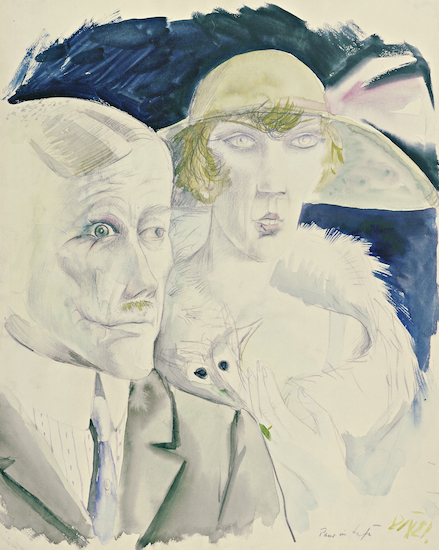 |
| Otto Dix (1891-1969 Germany) Café Couple, 1921, pencil and watercolor on paper, 20 1/16” x 16 1/8” (51 x 41 cm). The Museum of Modern Art, New York. © 2025 Artists Rights Society (ARS), New York (MOMA-P2370dxars) |
Dix produced many paintings on the subject of Café Couple, many of them in oil. This work may have been intended as a study, yet is finished enough to stand as a finished work. Dix chronicled the seedy nightlife and excesses of the upper classes of German society between the world wars. This version of the subject emphasizes the male figure seriously disfigured by what appear to be wounds suffered in the World War, in which Dix himself suffered an almost fatal neck wound. The artist emphasized the horror of the disfigurement by a darker value of the man's eyeball, which stands out against the overall light values in the painting. He relates that to the high value eyes of the dead fox around the woman's neck, a chilling linkage.
Background
The devastation and unprecedented bloodbath of World War I (1914-1918) had a profound impact on the course of modern art in the early 1900s. Artists who had experienced the horrors expressed their reactions visually in a variety of new types of abstraction, or naturalistic styles. There were even artists of the Dada movement who sought to redefine the nature of art, believing that war lacked logic, so, why should art be logical (traditional)?
After Germany's defeat in the war, some German Expressionists formed the "November Group". This group soon included the Dadaists. Also established after the war was the Workers' Council for Art, which advocated more state support for the arts and a revamping of art schools. Both groups imagined the aftermath of the war as an impetus to improve society based on socialist ideals. As the 1920s progressed, Germany became more right wing. The middle class who were the expected crop of art patrons did not trust the art groups' socialist ideals. The workers, who the artists looked to for support, also did not accept radical social change. Out of this emerged a new type of Social Realism in painting called the "New Objectivity".
This movement featured scathing critiques of German middle class society, the suffering of the poor and wounded veterans, and the decadence of the rich on realism that was tinged with Expressionist stylistic elements.
Otto Dix was the son of working class parents who was exposed to art at an early age. He spent time with a cousin who was a painter, and later apprenticed to a landscape painter. In 1910 he moved to Dresden and studied at the Saxon School of Arts and Crafts where he developed an Expressionistic style. One great influence on his work was the Naturalist/Symbolist printmaker Max Klinger (1857-1920).
Dix served in a machine gun and then an artillery unit during the war. He was wounded several times, almost fatally in 1918. All through the war, he kept a diary and sketchbook which documented his experiences. His experience with war and its aftermath became a dominant theme in his art.
Correlations to Davis programs: Explorations in Art 2E grade 1, 2.1, 2.2; Explorations in Art 2E grade 2, 2.2, 2.6, 5.1; Explorations in Art 2E grade 3, 1.1, 1.2, 1.3, 1.4; Explorations in Art 2E grade 4, 1.2, 2.1; Explorations in Art 2E grade 5, 1.1, 1.2, 1.8; Explorations in Art 2E grade 6, 1.1, 1.2, 1.3, 1.4; A Community Connection 2E, 2.3; A Personal Journey 2E, 2.1, 2.3; Experience Art p.33, 7.1; The Visual Experience 4E, 8.10; Discovering Drawing 3E chapter 7

Comments